What To Buy In Cusco
Cusco, the historic city in the Andes of southern Peru, is one of South America's great shopping cities, and most of what is worth buying is made within a day's reach of the Plaza de Armas at 3,335 m.
Short answer
The best things to buy in Cusco are woven textiles and alpaca wool, chocolate made from Peruvian cacao, ceramics, silverwork, Maras salt and pisco. Shop at San Pedro Market for food, the San Blas district for crafts, and check fibre quality before paying anything for alpaca.
Cusco, the historic city in the Andes of southern Peru, was the capital of the Inca empire and is today a UNESCO World Heritage city whose shops and markets sell work drawn from the whole surrounding region: wool from highland herds, cacao grown on the eastern slopes, salt harvested from terraces at Maras, and weaving traditions that survive in communities across the Sacred Valley. The shopping here rewards a little knowledge. Fibre quality varies enormously, some "alpaca" is a synthetic blend, and the difference between a good purchase and a disappointing one usually comes down to knowing what to look at rather than where to start haggling. This guide lays out what is genuinely worth buying in Cusco, where to buy it, what verified prices apply around the city, and how to tell the real thing from the imitation.
What Is Worth Buying In Cusco?
The purchases that consistently reward visitors to Cusco are woven textiles and alpaca knitwear, chocolate made from Peruvian cacao, hand-thrown ceramics, silverwork, salt from the Maras evaporation ponds, pisco and ground or whole Andean grains. Most of it is produced within the Cusco region, and the textiles in particular come from weaving communities whose techniques long predate the tourist trade.
That short list is not just a matter of taste. It reflects what the region actually produces. Alpacas are farmed across the high Andes of southern Peru, and the finest fibre is graded and sold into both the local market and the export trade. Cacao grows on the Amazonian slope several hours downhill from the city, and Cusco has its own chocolate museum and workshop where beans are turned into bars in front of visitors. The salt ponds at Maras, an easy day trip from the city, have been producing salt for local use for a very long time, and bags of it are sold in the city's markets at modest prices.
Silver deserves a mention too. Peru is one of the world's large silver producers, and Cusco workshops sell jewellery in the Andean style, often set with stones. Ceramics, from reproduction Inca vessels to modern painted pieces, come from neighbourhood workshops around the city. What is harder to recommend is the mass-produced souvenir tier: printed T-shirts, plastic trinkets and machine-made items shipped in from elsewhere. They are easy to find, but they are not what the region makes best.
Where To Go Shopping In Cusco: Markets, San Blas And Workshops?
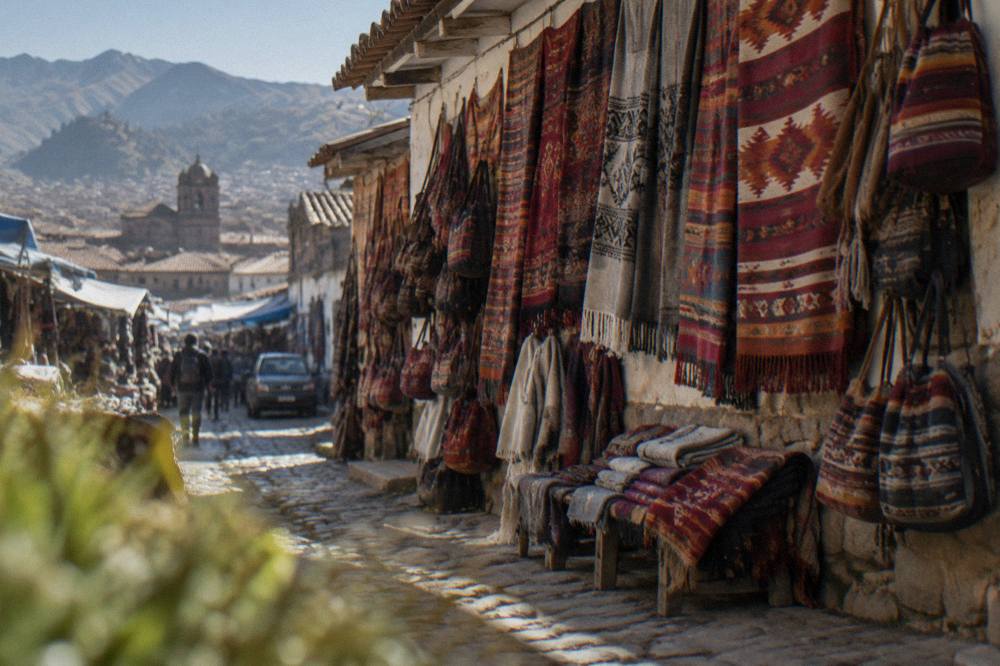
The three main shopping zones in Cusco are the central markets around San Pedro, the San Blas district uphill from the Plaza de Armas with its craft workshops and galleries, and the streets immediately off the Plaza de Armas, which carry the densest concentration of textile and jewellery shops. The market is for food and everyday goods, San Blas for one-off craft pieces, and the centre for convenience.
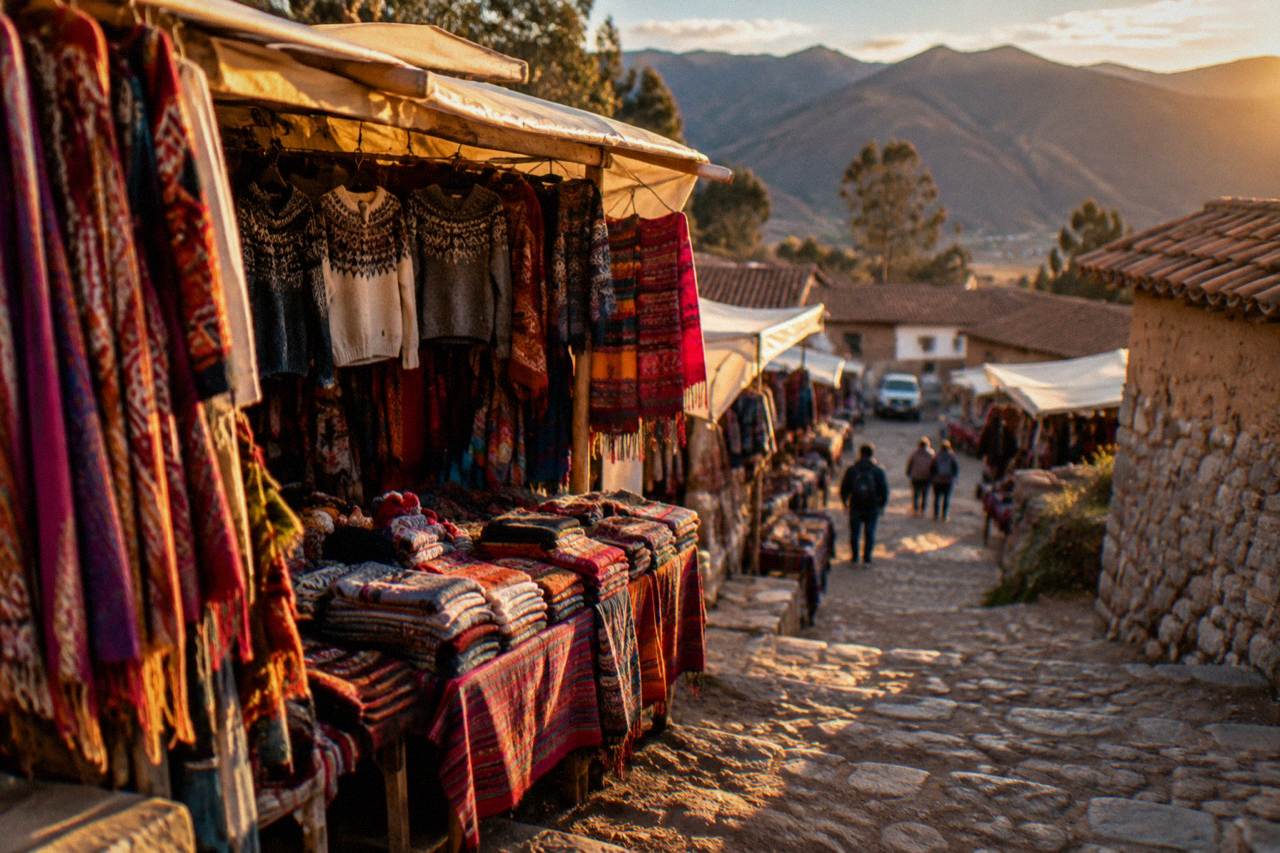
San Pedro Market is the city's central market and the best single place to buy foodstuffs: cacao and chocolate, quinoa and other grains, dried herbs, coca tea, cheese, bread and fruit. It sits a few minutes' walk from the Plaza de Armas, and the San Pedro Market guide covers its layout in detail. The surrounding streets hold smaller markets and a cluster of stalls aimed squarely at visitors, with textiles, jumpers and souvenirs in dense rows.
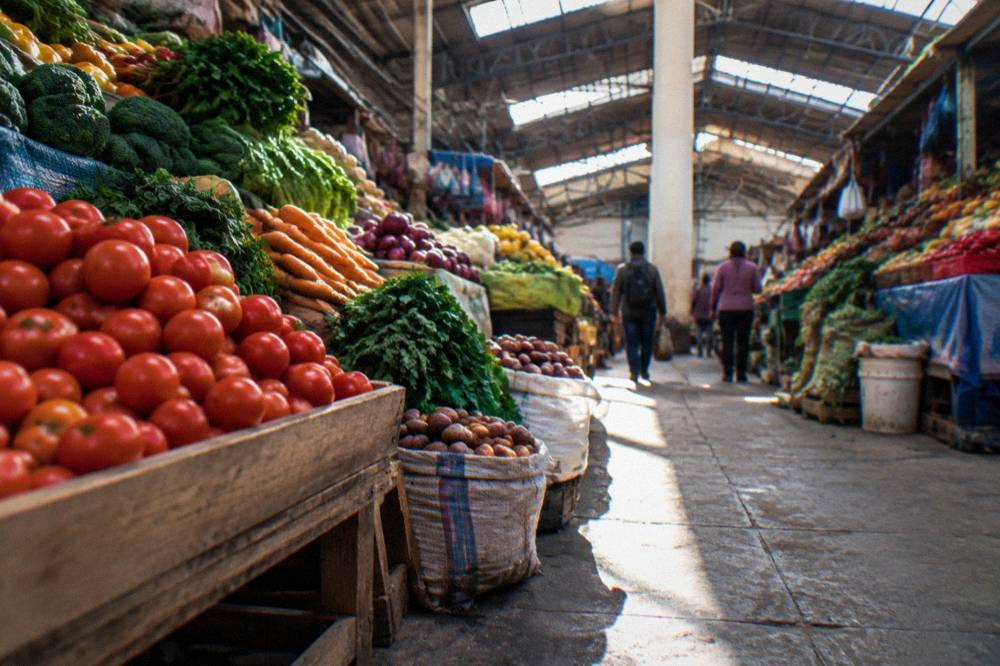
San Blas, the artisans' quarter, is where much of the individual work is sold. Workshops and small galleries line the streets around the neighbourhood's small square, and the walk up from the centre passes through some of the city's most photographed lanes. The San Blas guide lists the studios worth seeking out. For a deeper look at the whole market scene, the Cusco markets guide covers the smaller neighbourhood markets that lie beyond the usual sightseeing routes.
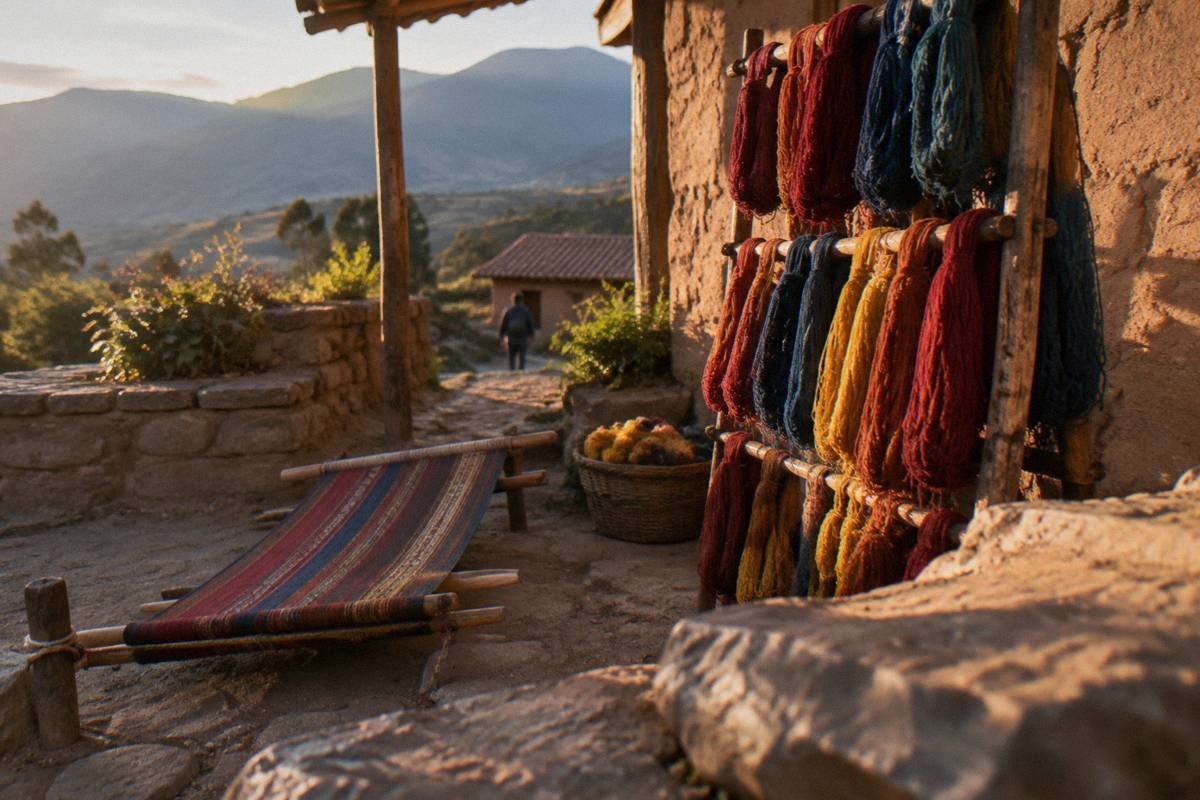
A different kind of shopping happens at the workshops themselves. The ChocoMuseo in the historic centre demonstrates bean-to-bar chocolate making and sells its own bars, as the ChocoMuseo guide explains, and a weaving centre such as Awana Kancha on the road out of the city shows the full chain from animal to finished textile. Seeing the process changes how a buyer judges the product.
How Can You Tell Real Alpaca From A Synthetic Blend In Cusco?
Real alpaca fibre is dense, slightly cool to the touch and has no synthetic sheen; a genuine baby-alpaca jumper will not pill immediately, carries no chemical smell when warmed, and the seller should let you test it. The surest check is the burn test on a loose thread: animal fibre smells of singed hair and crumbles to ash, while acrylic melts, hardens and smells of plastic. Sellers who refuse the test are answering the question themselves.
This is the single biggest quality question in Cusco shopping, and it is worth being direct about it. Much of what is sold as "alpaca" in the tourist streets is a blend, sometimes mostly acrylic, and the price gap between a synthetic jumper and a genuine baby-alpaca one is large. The buying alpaca in Cusco guide goes deeper, but the essentials travel well.
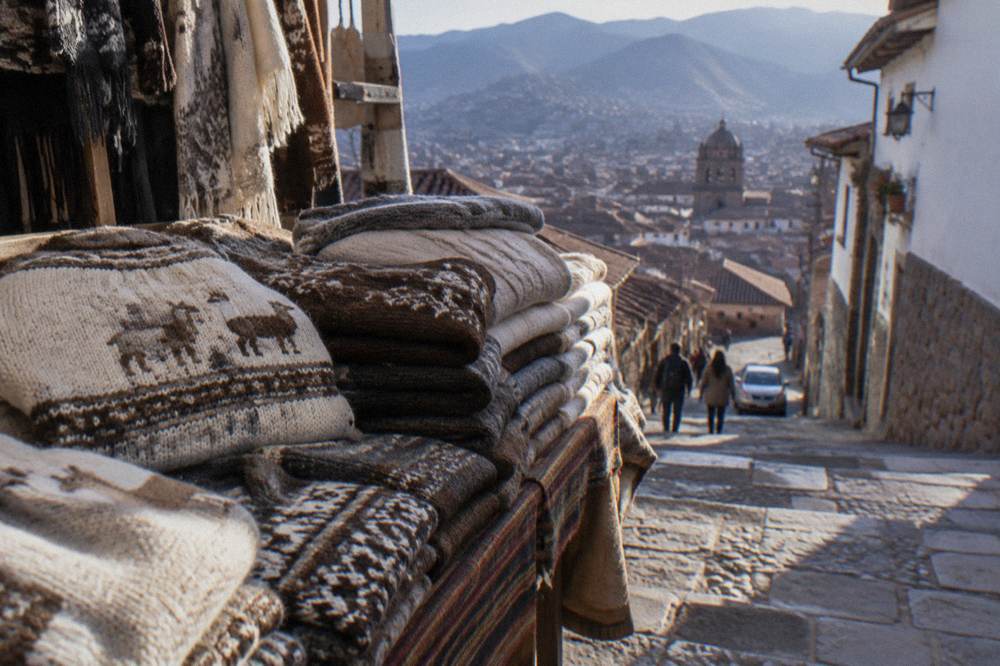
The vocabulary matters. "Baby alpaca" is a fibre grade, not an age: it refers to the finest first shearing, and it commands the highest prices. "Alpaca blend" is honest labelling if the seller states the percentage; "100 percent alpaca" at a price that seems too low usually is too low. Peru's official quality mark, granted to fibre that has passed laboratory grading, is the strongest single indicator when a shop displays it. Weaving cooperatives and workshops that let visitors watch the spinning and dyeing are, as a class, the most reliable places to buy, because the whole business model depends on the fibre being what they say it is.
No verified price band for alpaca goods appears on this site, and no number is invented here. What can be said is that quality, grade and handwork drive the price, and that comparing several shops before buying costs nothing. A workshop visit such as Awana Kancha, covered in the Awana Kancha guide, shows what hand-spinning and natural dyeing actually look like, which sharpens the eye everywhere else.
What Food And Drink Should You Take Home From Cusco?
The food and drink most worth carrying home from Cusco are Peruvian chocolate and raw cacao, quinoa, kiwicha and other Andean grains, Maras salt, coca and herbal teas, pisco, and coffee grown at lower altitude on the region's eastern slope. All of it packs well, keeps without refrigeration, and is bought at its cheapest inside the central market rather than in souvenir shops.
Chocolate is the easy winner for gifts. Peruvian cacao is internationally recognised, the ChocoMuseo makes and sells its own bars on site, and the workshops let a buyer see the bean-to-bar process before choosing. Quinoa needs no introduction, but the market sells varieties and colours a supermarket abroad does not, and the same is true of kiwicha and canihua. Maras salt, from the evaporation ponds described in the Maras salt mines guide, comes in small bags that weigh little and carry a genuine story.
| Product | Where To Buy It | What To Check |
|---|---|---|
| Chocolate and cacao | ChocoMuseo and market stalls | Cocoa percentage and origin stated |
| Quinoa and Andean grains | San Pedro Market, bulk stalls | Sealed, clean, no damp smell |
| Maras salt | Market stalls, or at Maras itself | Coarse traditional pink salt |
| Coca and herbal teas | San Pedro Market | Sealed bags for customs |
| Pisco | Licensed shops in the centre | Bottled, sealed, labelled |
| Coffee | Roasters in the centre | Roast date and altitude-grown label |
Pisco, Peru's grape brandy, is sold in sealed bottles in the centre's shops; check the customs allowance of the home country before buying. Coffee from the region's lower slopes is roasted in the city and sold fresh. A cooking class with a market tour is the most efficient way to learn the ingredients before buying them, and the Cusco cooking classes guide covers the options.
What Does Shopping In Cusco Cost?
Everyday shopping costs in Cusco are low by international standards: a cup of coca tea is reported at about S/ 2 to S/ 5, a set lunch menu at about S/ 8 to S/ 15, and a tourist SIM card at about S/ 5 to S/ 15 plus a data pack at about S/ 20 to S/ 40. The currency is the Peruvian sol, written S/, at about S/ 3.4 to the US dollar, and souvenir prices are negotiated in markets and fixed in shops.
The sol is the currency, and the Central Reserve Bank of Peru quotes it against the US dollar; the working rate for a visitor is about S/ 3.4 to the dollar. Cards are accepted in established shops, while the markets run on cash. The verified, published prices a shopper is most likely to encounter while walking the city and its surroundings are listed below; they are the official COSITUC ticket prices, museum admissions listed by Peru's tourism board, and community fees reported at the sites. Other pages covering the same trip are gathered on Things To Do In Cusco Peru.
| Item | Price | Source Notes |
|---|---|---|
| Boleto Turistico integral (foreign adult) | S/ 130, 10 days | COSITUC official tarifario |
| Boleto partial circuit (I, II or III) | S/ 70 each | COSITUC official tarifario |
| Qorikancha museum | S/ 20 | peru.travel listing |
| Inca Museum | S/ 20 | peru.travel listing |
| Museo de Arte Precolombino | S/ 20, students S/ 10 | peru.travel listing |
| Cusco Cathedral | S/ 25 | peru.travel, dated listing |
| Rainbow Mountain community fee | S/ 25 to S/ 30, cash | peru.travel and operators |
| Palccoyo fee | about S/ 20 | 2026 operator listings |
| Maras salt mines entry | S/ 15 to S/ 20 | 2026 operator listings |
| Coca tea (cup) | about S/ 2 to S/ 5 | reported range |
| Menu del dia (set lunch) | about S/ 8 to S/ 15 | reported range |
| Tourist SIM plus data pack | about S/ 5 to S/ 15 plus S/ 20 to S/ 40 | reported range |
Two cautions go with that table. The Boleto Turistico is sold in person only, at the COSITUC counter on Avenida El Sol and at most included sites, not online, as the Boleto Turistico guide explains. And no verified price band for alpaca knitwear, blankets or sweaters exists on this site, so none is printed: fibre grade and handwork decide those prices, and comparing shops is the only honest method.
When Is The Best Time Of Year To Shop In Cusco?
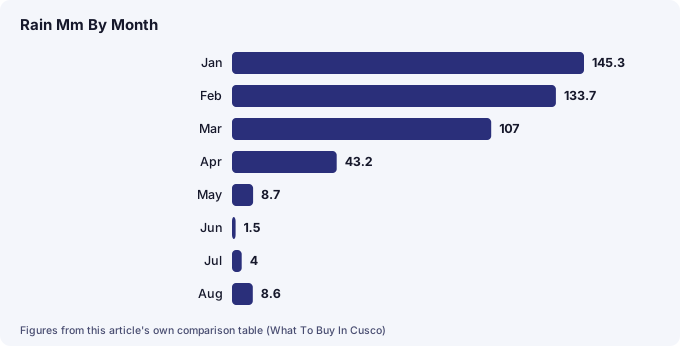
The best months for shopping in Cusco are May to September, the dry season, when streets and market stalls are reliably open and the days are clear; December is special because the Santurantikuy craft fair fills the Plaza de Armas on 24 December. The wet season from roughly November to March brings afternoon rain, and December to March carries 71.9 percent of the year's 707.8 mm of rainfall at the WMO/SENAMHI Cuzco station.
Cusco sits in the southern hemisphere at high altitude, so the seasons are the reverse of Europe's and North America's. June to August is winter: dry, clear, and cold at night, with frost common in June and July. Daytime maximums barely change across the year, holding between 18.8 and 20.9 C on the historical normal, which means a shopping day in July feels cold only after the sun drops.
| Month | Mean Max C | Mean Min C | Rain mm |
|---|---|---|---|
| Jan | 18.9 | 6.6 | 145.3 |
| Feb | 18.8 | 6.5 | 133.7 |
| Mar | 19.1 | 6.2 | 107.0 |
| Apr | 19.7 | 4.9 | 43.2 |
| May | 19.8 | 2.5 | 8.7 |
| Jun | 19.5 | 0.3 | 1.5 |
| Jul | 19.1 | 0.1 | 4.0 |
| Aug | 19.8 | 1.6 | 8.6 |
| Sep | 19.8 | 3.9 | 21.8 |
| Oct | 20.9 | 5.5 | 39.4 |
| Nov | 20.7 | 6.1 | 71.9 |
| Dec | 19.4 | 6.4 | 122.7 |
That table is the historical normal supplied by SENAMHI, Peru's weather service, to the World Weather Information Service. The Cusco weather by month guide unpacks it, and the best time to visit Cusco guide weighs it against crowds and prices.
For shoppers specifically, two calendar notes matter. Santurantikuy, the Christmas Eve craft fair on the Plaza de Armas, fills the square with artisans selling nativity figures and woodcarvings, and it is the one day the shopping comes to the shopper. And Inti Raymi on 24 June, the Inca sun festival described in the Inti Raymi guide, draws large crowds to the city; shops stay open, but accommodation and patience both run short, as the Cusco festivals pages describe.
Can You Bargain In Cusco Markets?
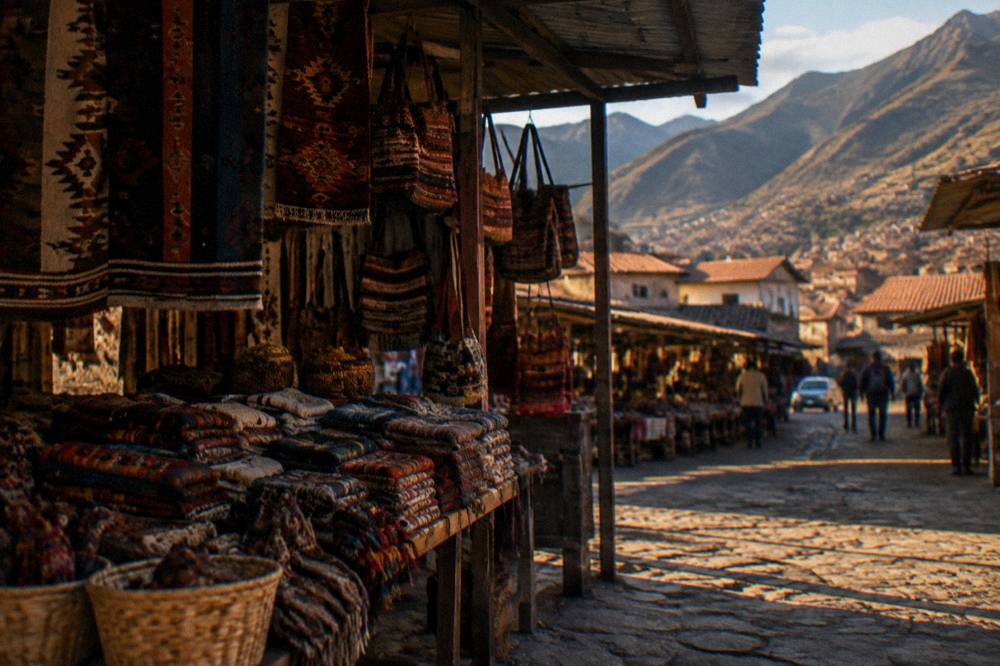
Bargaining is normal in Cusco's markets and street stalls, expected on textiles and souvenirs, and inappropriate in fixed-price shops, the central market's food stalls and restaurants. A polite approach works: ask the price, counter lower, and keep it friendly; the Peru travel guidance on tipping culture treats negotiation as part of market life, while established shops post prices and stick to them.
The etiquette is straightforward. In the artisan stalls, a first price is an opening position, and a calm counteroffer is not offensive. Food inside San Pedro Market, restaurant menus and the shops around the Plaza de Armas operate on fixed prices. What is never acceptable is aggressive haggling over a small sum with an artisan who wove the item by hand; the free things to do in Cusco guide notes how much of the city's craft economy runs on individual makers.
Tipping, which is related market-and-service money, has published guidance from one Peru travel guide: in restaurants leave up to 10 percent only if no service charge is already on the bill, free walking tours run on tips of roughly S/ 20 to S/ 40 per person, day-tour guides are tipped about S/ 10 to S/ 20 and drivers S/ 5 to S/ 10 per person, and porters receive a few soles per bag. Those are editorial ranges from a Peru travel site, not official tariffs.
| Situation | Bargain? | Notes |
|---|---|---|
| Artisan street stalls | Yes, politely | Counter once, keep it friendly |
| San Pedro Market food stalls | No | Fixed prices by weight or portion |
| Fixed-price shops in the centre | No | Posted prices |
| Workshops and cooperatives | Rarely | Prices reflect handwork |
| Restaurants and cafes | No | Tip up to 10% if no service charge |
How Do You Avoid Fakes And Tourist Traps When Shopping In Cusco?
To avoid fakes in Cusco, buy from workshops and cooperatives where production is visible, ask for the burn test on any claimed alpaca, distrust "100 percent alpaca" at very low prices, keep receipts for silver and pisco, and be sceptical of any "authentic antique", which export rules restrict. The city's tourist police and the iPeru tourist information service both exist to help visitors who feel cheated.
The fake problem concentrates in three areas: fibre, silver and antiquities. Fibre is covered above. Silver should be bought from shops that state the grade of the metal and that stamp their pieces. Antiquities are the sharpest edge: real pre-Columbian objects cannot legally be exported, and anything presented as a genuine antiquity for sale to a visitor is either fake or a legal trap. Reproductions, clearly labelled as such, are the honest version of that market.
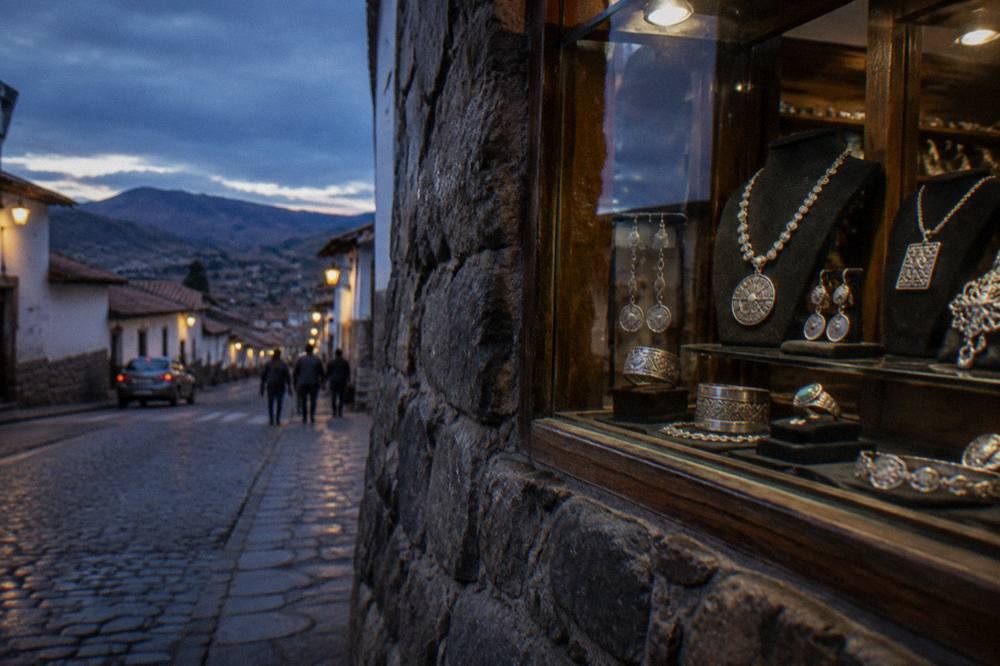
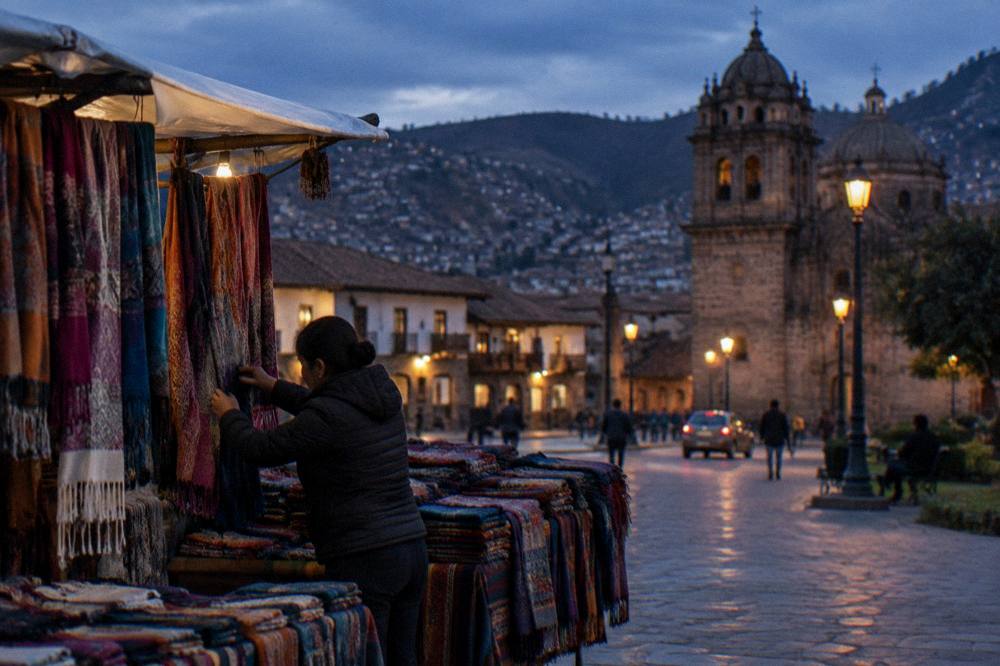
The tourist-trap problem is smaller than in many cities, but it exists. The streets closest to the Plaza de Armas carry the highest rents and the most generic stock; walking ten minutes to San Blas or taking a bus to the Sacred Valley weaving towns improves both quality and price. Peru's official tourist information service, iPeru, operates a 24-hour line, and the tourist police maintain a dedicated WhatsApp number; both are listed on Peru's tourism board emergency pages. The is Cusco safe guide covers the wider safety picture, including the standard advice against walking alone at night in quiet areas.
For anyone buying in quantity, a shipping note: many established textile shops will arrange courier dispatch abroad, and a shop that has done it before is safer than a stall that has not. Ask for the paperwork before paying, and photograph anything valuable before it is wrapped.
Where Can You Buy What Cusco Sells At Its Source?
The strongest source purchases around Cusco are salt at Maras, textiles in the Sacred Valley weaving towns such as Chinchero and Pisac, cacao and chocolate in the city's own workshops, and ceramics at Ollantaytambo, all reachable as day trips; buying at the source shortens the chain, usually lowers the price and always carries the story.
Chinchero, covered in the Chinchero guide, is the weaving heart of the valley: community workshops demonstrate the full chain from washing raw fleece to finished cloth, and sell directly. Pisac, in the Pisac guide, pairs its famous hilltop ruins with a market town. Maras sells its salt at the ponds themselves, which is where it is cheapest and most genuine. Ollantaytambo, in the Ollantaytambo guide, is a living Inca town with ceramics and textiles in its small streets.
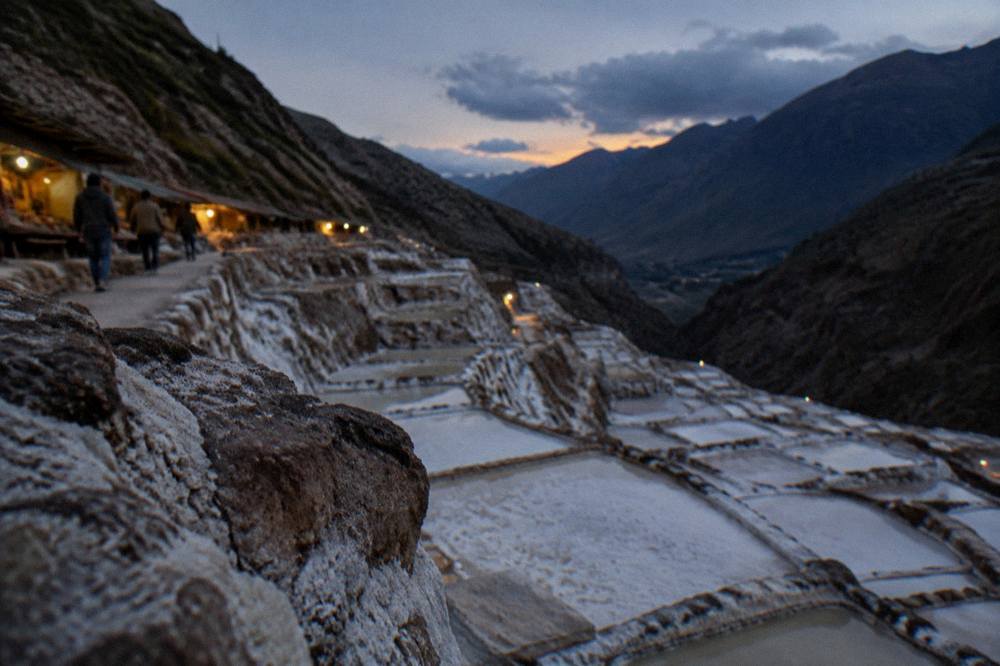
A day trip that combines shopping with the landscape is the quad-bike route to Moray and the Maras salt mines, where the ride crosses the high plain between the two sites; the Sacred Valley guide lays out the geography. And for visitors whose itinerary ends at Machu Picchu, the one page on this site for that destination, the Machu Picchu day trip guide, notes that Aguas Calientes below the citadel has its own artisan market, though the citadel itself is lower than Cusco, at 2,430 m against the city's 3,335 m, and the shopping there is thinner.
Common Questions About Shopping In Cusco
What Is The Best Souvenir To Buy In Cusco?
A piece of genuine alpaca knitwear or a handwoven textile is the souvenir most tied to the region, and it is what Cusco's own workshops build their reputation on. Chocolate made from Peruvian cacao is the easiest gift to carry and share, and Maras salt is the lightest genuine product with a real story behind it.
Is Alpaca Wool Cheap In Cusco?
No verified price band for alpaca goods is published on this site, so no figure is invented. What can be said is that buying closer to the source, at workshops and cooperatives rather than airport-adjacent shops, gives the same fibre grade for less money, and that genuine baby alpaca always costs meaningfully more than a synthetic blend.
What Should You Not Buy In Cusco?
Do not buy anything presented as a genuine pre-Columbian antiquity: real artefacts cannot legally be exported, so the item is either a fake or a legal problem. Be cautious with unlabelled "alpaca" at very low prices, and with any food product sold unsealed if it is destined for a customs inspection at home.
Do Shops In Cusco Take Credit Cards?
Established shops in the historic centre generally take cards; the markets and street stalls run on cash in soles. ATMs are widespread, and one Peru travel guide reports per-transaction withdrawal caps of roughly 400 to 700 soles, with bank machines usually cheaper than airport and hotel ATMs. Declining the machine's offer to convert to a home currency is standard practice.
When Is The Santurantikuy Craft Fair In Cusco?
Santurantikuy fills the Plaza de Armas on 24 December each year. Artisans from across the region sell nativity figures, woodcarvings and retablos, and it is the single best shopping day of the Cusco calendar for one-off craft pieces.
Can You Ship Purchases Home From Cusco?
Established textile and silver shops in the centre can arrange courier dispatch abroad, and a shop that ships regularly will produce the paperwork without hesitation. Get the dispatch details and a photograph of the item before paying, and prefer a shop with a fixed address over a stall.
Shopping in Cusco is one of the few tourist activities that improves with patience rather than money: the same city sells machine-made blends and hand-spun, naturally dyed, hand-woven cloth, and the difference is learnable in a single afternoon. Start at the market, walk up to San Blas, test every fibre claim, and buy the things the region actually makes.