San Pedro Market Cusco
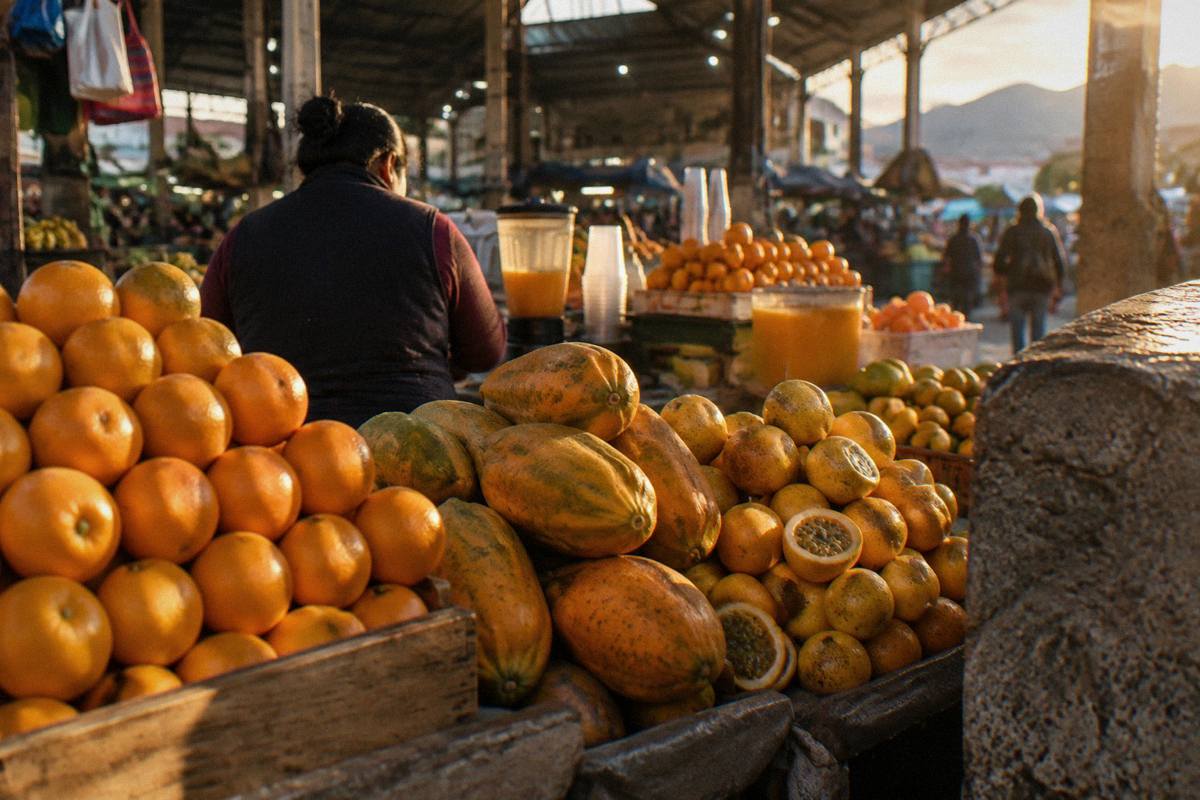
San Pedro Market is the central food market of Cusco, Peru: produce stalls, juice counters, hot Andean food stands and craft sellers at the edge of the historic centre, at about 3,335 m in the Andes of southern Peru.
Short answer
San Pedro Market is the central covered food market of Cusco, Peru, beside the church of San Pedro at the edge of the old quarter. Expect produce, fresh juices, hot food counters and craft stalls; a menu del dia is reported at about S/ 8 to 15 and a coca tea at about S/ 2 to 5.
San Pedro Market is the central food market of Cusco, the historic city in the Andes of southern Peru, standing beside the church that shares its name at the edge of the old quarter. The Plaza de Armas, the heart of the city at 3,335 m, sits a short walk away, and the market serves the city that lives around it: stalls of produce, counters of fresh juice, hot food stands and sellers of textiles and household goods. This guide sets out what the market is, what to eat and buy there, what the nearby sites cost, and how to plan a day around it, drawing on official sources and reported on-the-ground price ranges.
What Is San Pedro Market In Cusco?
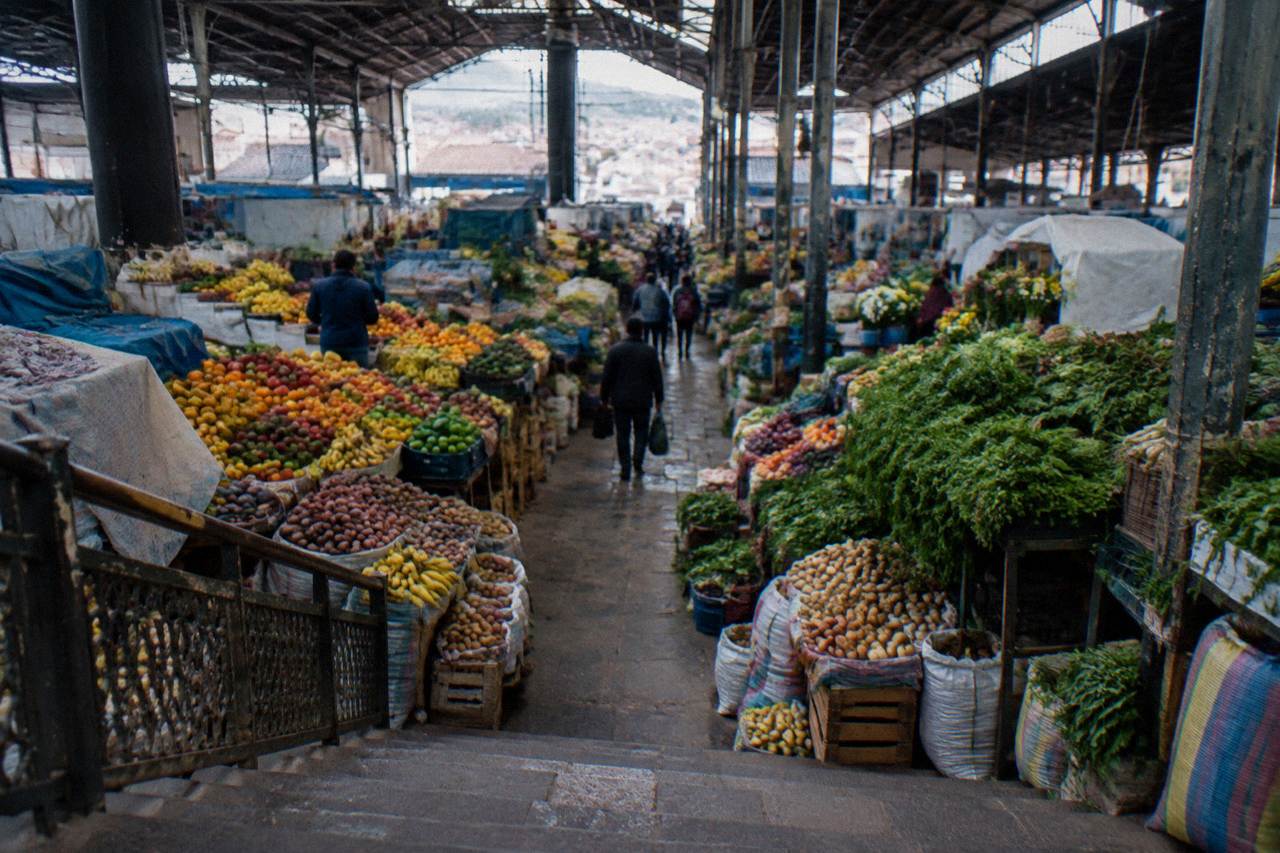
San Pedro Market is Cusco's central covered food market, a working hall of produce stalls, juice counters, hot food stands and craft sellers near the church of San Pedro at the edge of the historic centre. It is not an attraction built for visitors; it is where the city shops, and its stalls carry Andean potatoes, large-kernel corn, fresh cheeses, breads, meats and prepared dishes.
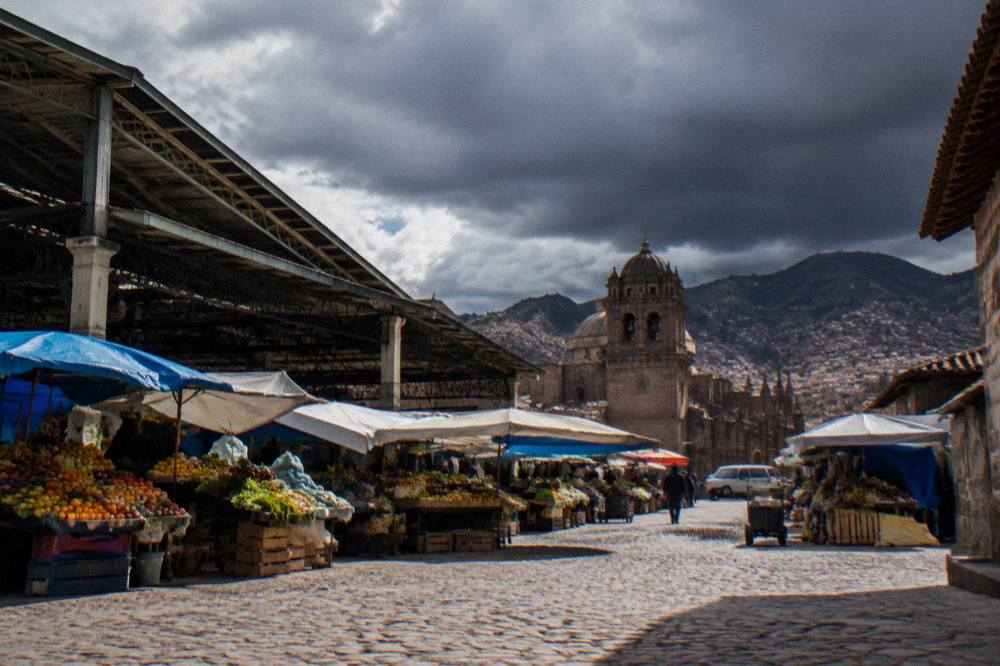
The market sits in the part of Cusco where the tourist quarter gives way to the working city, and that mix is exactly what a visitor notices first. One aisle holds pyramids of tomatoes, herbs and breads; another holds juice counters with jars of tropical fruit that the highlands themselves cannot grow; another holds food stands serving hot meals to locals on their lunch break. A craft and textile section rounds it off for gift buyers. The site's own place record puts the market at the old quarter's edge, near the church of San Pedro, which is the landmark to aim for when finding the way.
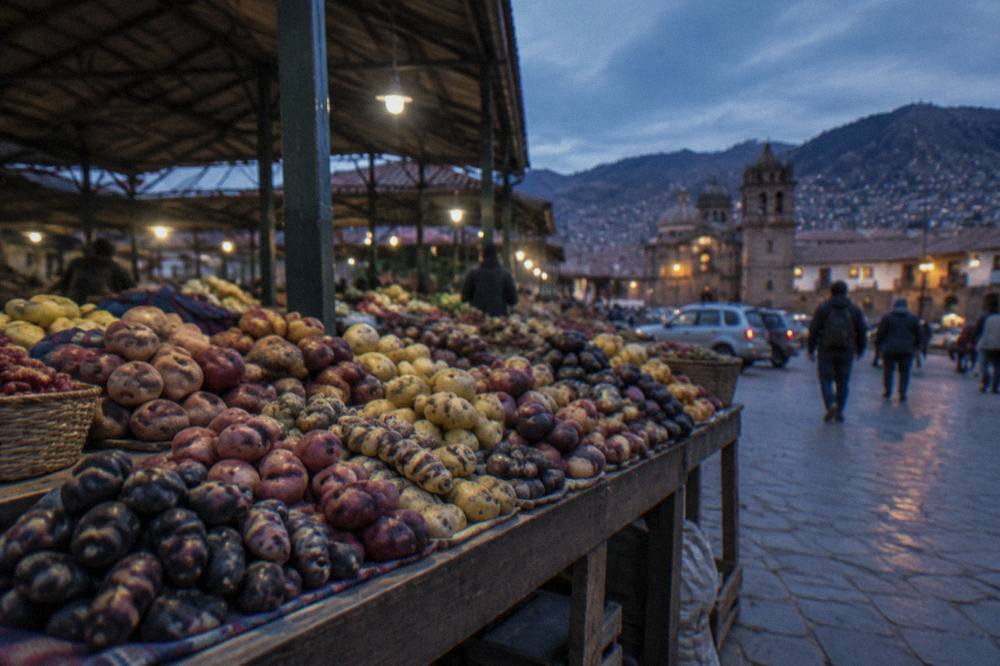
The Andean pantry is the reason many travellers end up here at all. Peru's highlands grow an extraordinary range of potatoes and grains, and a market is where that range is visible in one place: potatoes in colours from gold to deep purple, ears of choclo corn with kernels the size of coins, quinoa and other grains sold by weight, and fresh cheeses made in the surrounding valleys. None of this needs a ticket or a guide. The market anchors the practical, everyday side of a Cusco trip, the side Things To Do In Cusco Peru covers alongside the headline ruins and treks.
Where Is San Pedro Market Cusco And What Else Is Nearby?
San Pedro Market stands at the edge of Cusco's historic centre, beside the church of San Pedro, a short level walk from the Plaza de Armas with no significant climb involved. The streets around it hold several of the city's headline sights: Qorikancha, the Inca Museum, the Cathedral on the Plaza, and the San Blas quarter on the hill to the east, all reachable on foot from the market.
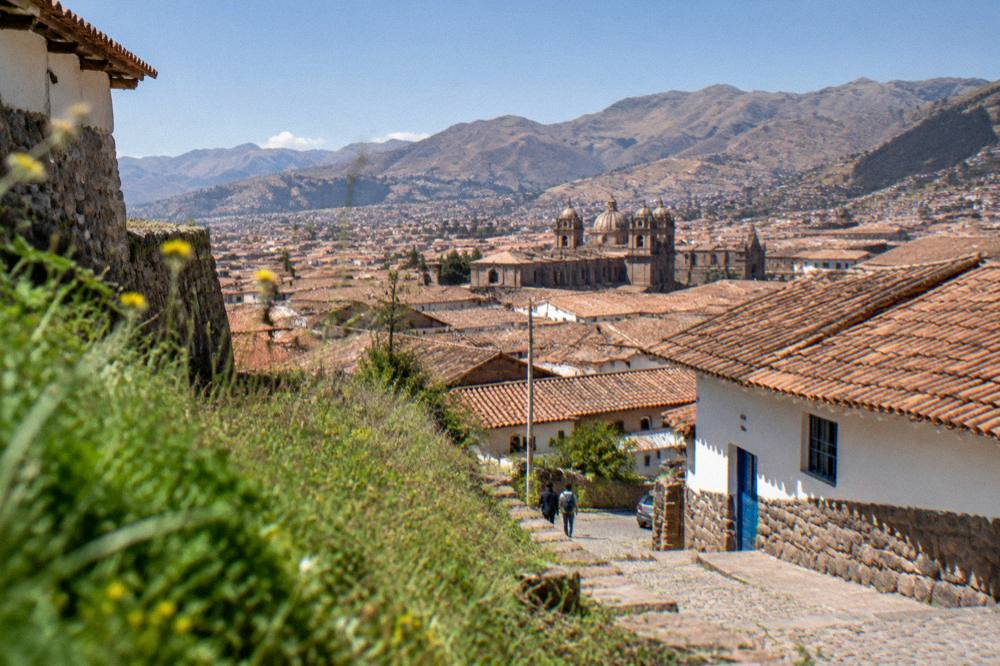
The old centre of Cusco is compact, and the market sits at the useful end of it. The Plaza de Armas in central Cusco is the reference point for the whole city, and from the market the walk to it is flat by Cusco standards. Qorikancha and its museum, the Inca temple site under the church of Santo Domingo, is one of the closest major sights, and the Inca Museum nearby is a short distance further on. The Cusco Cathedral on the main square and the twelve-angled stone on Hatunrumiyoc are both natural stops on the same loop, and the San Blas quarter on the hill rises to the east of the Plaza for anyone with the energy for the climb.
The museums closest to the market carry their own admissions, and peru.travel lists the current figures. The Qorikancha museum at Santo Domingo is listed at S/ 20, and the same site appears on the COSITUC Boleto Turistico as the Museo de Sitio Qorikancha on Circuit II. The Inca Museum is listed at S/ 20, the Museo de Arte Precolombino at S/ 20 general and S/ 10 for students.
| Site near the market | Listed admission | Notes |
|---|---|---|
| Qorikancha museum, Santo Domingo | S/ 20 | peru.travel; also on the Boleto Circuit II as Museo de Sitio Qorikancha |
| Inca Museum | S/ 20 | peru.travel; listed hours Mon to Fri 09:15 to 16:00, Sat 09:15 to 14:00 |
| Museo de Arte Precolombino (MAP) | S/ 20 general, S/ 10 students | peru.travel |
| Cusco Cathedral | S/ 25 | peru.travel page dated 2021; confirm on the day, may have changed |
The Boleto Turistico itself is the better buy if several of these sites are on the list, because its city circuit covers a cluster of museums around the market. The COSITUC tarifario states the prices plainly: the integral ticket for a foreign adult is S/ 130 and covers all 16 sites, and each of the three partial circuits is S/ 70.
| Boleto Turistico ticket | Price | Validity | What it covers |
|---|---|---|---|
| Integral, foreign adult | S/ 130 | 10 days | All 16 COSITUC sites |
| Partial Circuit I, Saqsaywaman | S/ 70 | 1 day | Saqsaywaman, Q'enqo, Puka Pukara, Tambomachay |
| Partial Circuit II, City | S/ 70 | 2 days | City museums incl. Museo de Sitio Qorikancha, Museo Historico Regional and others |
| Partial Circuit III, Sacred Valley | S/ 70 | 2 days | Pisac, Ollantaytambo, Chinchero, Moray |
| Integral, foreign student | S/ 70 | 10 days | All 16 sites, with student ID |
One point from the COSITUC FAQ matters for planning: the Boleto Turistico is not sold online. It is bought in person at the Counter Central on Av. El Sol 103, open Monday to Sunday 07:30 to 18:00, or at most of the included sites. Validity starts the day it is bought, and the FAQ notes that covering all 16 sites takes a minimum of three days.
What To Eat At San Pedro Market Cusco
The food counters at San Pedro Market serve Andean dishes straight from the stall: quinoa and vegetable soups, roasted and fried meats, papas in dozens of varieties, choclo corn, cheeses and breads, plus counters of fresh fruit juice. A menu del dia, the fixed market lunch, is reported at about S/ 8 to 15, and a cup of coca tea at about S/ 2 to 5; both are reported ranges, not official tariffs.
The juice counters are the market's signature stop. The highlands around Cusco sit too high for tropical fruit, so the lowland produce arrives by road and lands in glass jars at the market: mango, passionfruit, papaya and the local favourites, blended to order. The food stands around them cook the dishes that define the region's everyday table, soups built on quinoa and local grains, potatoes served in more colours than a supermarket stock, corn in giant kernels, and roasted and fried meats. Cuy, guinea pig, is a traditional Andean dish eaten across the region, and it appears on market menus without ceremony.
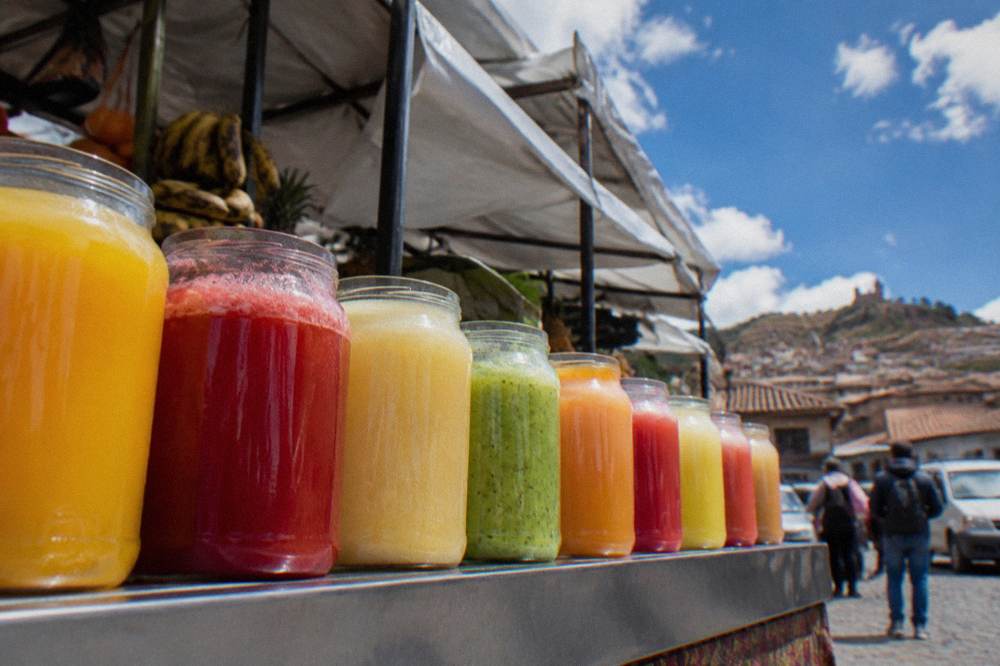
For budgeting, the reported on-the-ground ranges for central Cusco give a realistic frame. A menu del dia is reported at about S/ 8 to 15, a cup of coca tea about S/ 2 to 5, a tourist SIM about S/ 5 to 15 with data packs at about S/ 20 to 40, and an airport taxi to the centre about S/ 15 to 25. These are ranges that operators and local guides report, not official tariffs, and individual stalls set their own prices.
| Everyday item, central Cusco | Reported range | What to expect |
|---|---|---|
| Menu del dia, fixed market lunch | about S/ 8 to 15 | Soup, a main and a drink at food counters |
| Cup of coca tea | about S/ 2 to 5 | Served at counters and nearby cafes |
| Tourist SIM | about S/ 5 to 15, plus about S/ 20 to 40 for data | Sold with data packs in the city centre |
| Airport taxi to the centre | about S/ 15 to 25 | Fares are shown or agreed before the ride |
For anyone who thinks in dollars, the rough conversions at about S/ 3.4 to the US dollar work out as follows for the figures that appear around the market and its museums.
| Sol price | About US dollars |
|---|---|
| S/ 20 | about US$6 |
| S/ 25 | about US$7 |
| S/ 30 | about US$9 |
| S/ 70 | about US$20 |
| S/ 130 | about US$38 |
The market also works as an eating destination with a guide attached. A small-group street food walk limited to ten people or fewer stops at the market and other downtown stands, tasting papas, meats and sweets while talking with the vendors. The roster carries it as the Curious Monkey street food walk and as a central market food walking tour, and the product cards print the live prices and ratings.
The cooking class and San Pedro Market tour on the roster goes one step further than a food walk: it pairs a guided market visit, shopping for the ingredients, with a small-group class that turns them into a Peruvian meal. For travellers who want the market to explain the cuisine rather than just feed them, it is the natural pairing, and the operator's live listing shows the current price and terms: Check availability.
To shop the aisles and then cook what you found, book a cooking class with market tour here.
What To Buy At San Pedro Market Cusco
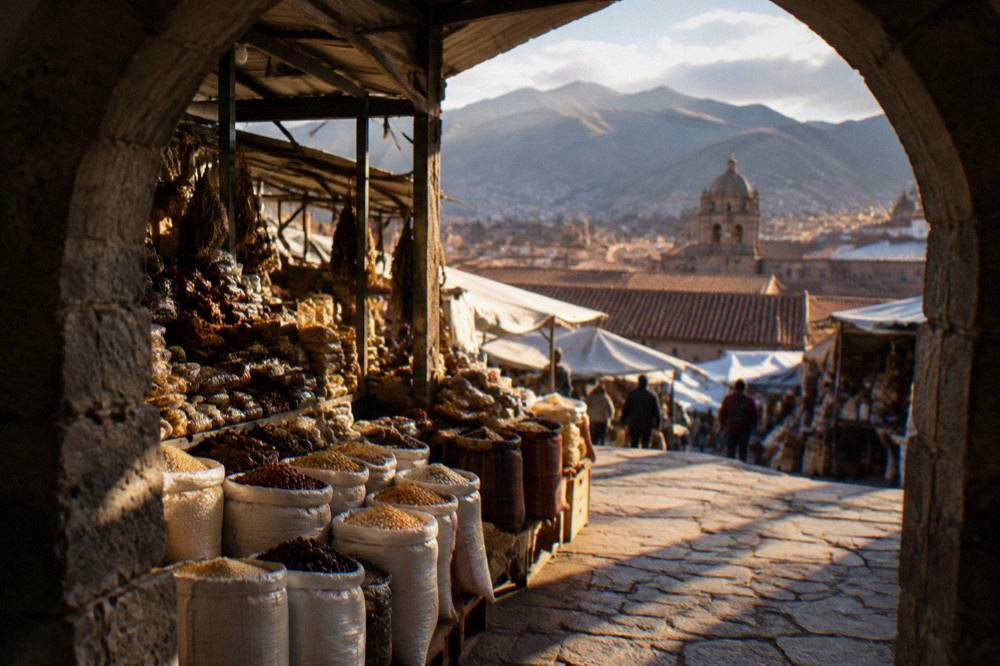
San Pedro Market sells the full range of a working Andean market: fresh produce, grains and pulses, breads, cheeses and meats, household goods, and a craft and textile section aimed at gift buyers. Knitwear, woven cloth, bags and hats are the usual finds there; for verified weaving demonstrated by the makers themselves, the Awana Kancha textile centre on the road out of the city is the established place.
The produce aisles make good souvenirs in themselves, in the form of grains, chocolate, cacao and coffee that travel well. The craft section leans toward textiles: alpaca and wool jumpers, scarves, blankets and hats, alongside bags and smaller woven pieces. Quality varies by stall, as it does in any working market, and the market's own stalls carry no verified grading, so the pieces are sold as they are seen.
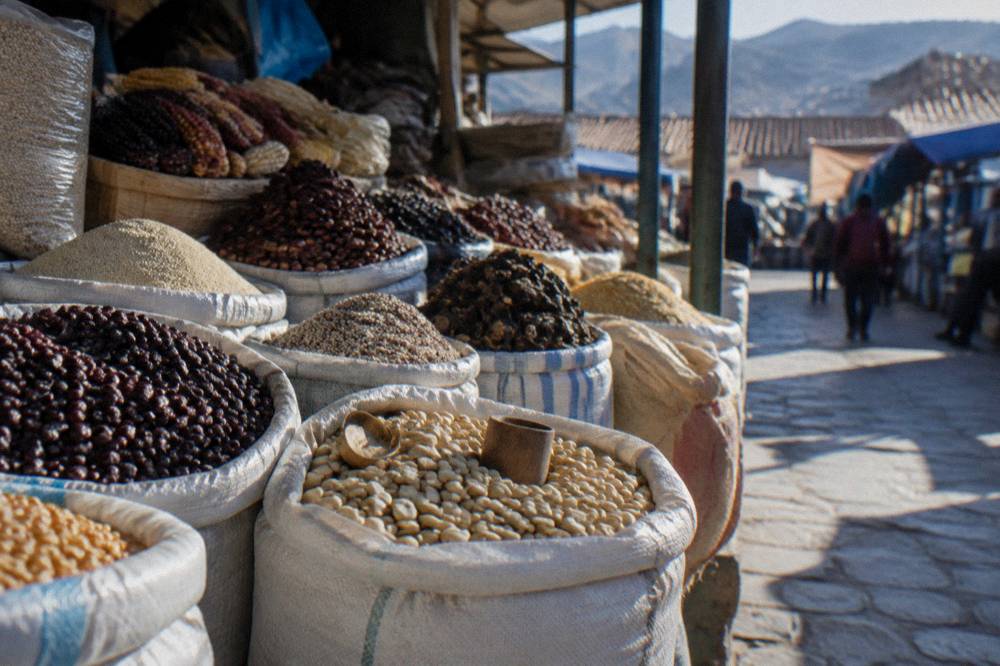
Two nearby stops deepen a shopping afternoon. The Awana Kancha weaving centre shows weaving and dyeing done by Andean women from the surrounding communities, which is where the craft on the market stalls originates, and the ChocoMuseo chocolate workshop turns cacao into chocolate by hand. Both are covered by their own pages on this site, and both sit within easy reach of a market morning.
Is San Pedro Market Cusco Safe To Visit?
The UK foreign travel advice records street crime, including muggings and thefts, as a significant problem in Cusco and Peru's other major cities, and advises against walking alone in quiet areas or at night; the US advisory for Peru stands at Level 2, exercise increased caution, with Cusco city outside the Do Not Travel areas. A central market in daylight fits the usual precautions those advisories describe.
The FCDO wording is direct about the cities, and Cusco is named among them. The same page advises against walking on your own in quiet areas or at night, and notes express kidnapping by fake taxi drivers, usually at night. None of that singles out a central market; it describes the city's general pattern, and the practical reading is the ordinary one for a South American city: daylight, central, populated areas are the setting the advisories themselves work from.
Peru maintains tourist-specific services that peru.travel lists in its emergency guidance. The Policia de Turismo runs a 24-hour phone and WhatsApp line on 980 122 335, and iPeru, the tourist information service, answers on WhatsApp at +51 944 492 314 and by phone on (01) 574 8000, around the clock. Those numbers are the official ones to hold for any visit to the city, market day included.
When Is The Best Time To Visit San Pedro Market Cusco?
The dry season in Cusco runs roughly May to September and the wet season roughly November to March, and a covered central market works in both; the WMO station record for Cuzco shows December to March carrying 71.9 percent of the year's 707.8 mm of rain, against just 22.8 mm across May to August. Mean daily maximums stay between 18.8 and 20.9 C all year, so the choice is about rain, not heat.
The numbers behind that answer come from the Cuzco station record supplied by SENAMHI, Peru's weather service, to the World Meteorological Organization, a historical normal rather than a recent one. The monthly pattern is unambiguous: the wettest month, January at 145.3 mm, carries a hundred times the rain of June or July. Cusco's winter, June to August, is dry with clear days and cold nights, and SENAMHI notes frost is common in June and July, with mean minima hovering near zero.
| Month | Mean max C | Mean min C | Rain mm |
|---|---|---|---|
| Jan | 18.9 | 6.6 | 145.3 |
| Feb | 18.8 | 6.5 | 133.7 |
| Mar | 19.1 | 6.2 | 107.0 |
| Apr | 19.7 | 4.9 | 43.2 |
| May | 19.8 | 2.5 | 8.7 |
| Jun | 19.5 | 0.3 | 1.5 |
| Jul | 19.1 | 0.1 | 4.0 |
| Aug | 19.8 | 1.6 | 8.6 |
| Sep | 19.8 | 3.9 | 21.8 |
| Oct | 20.9 | 5.5 | 39.4 |
| Nov | 20.7 | 6.1 | 71.9 |
| Dec | 19.4 | 6.4 | 122.7 |
For a market visit specifically, the covered hall is the point: rain matters less inside than on the walking routes between sights. The wet-season trade-off is the setting, not the shopping, and the monthly visitor figures on the home page of this site track the same May-to-October concentration the region-wide data shows.
How To Plan A Day Around San Pedro Market Cusco
A day around San Pedro Market pairs easily with the old quarter's sights and with the acclimatisation day that the CDC Yellow Book favours: it names Cusco, at about 3,350 m by its measure, a rapid-ascent destination and prefers graded ascent. The market itself is flat, central and low-effort, and the surrounding region runs from the 3,701 m Saqsaywaman hills above the city down through the Sacred Valley towns to Machu Picchu at 2,430 m.
The CDC's altitude guidance gives the frame. The Yellow Book advises avoiding a single-day jump to a sleeping altitude of 2,750 m or more, moving sleeping altitude by no more than 500 m per night once above 3,000 m, and considering acetazolamide to speed acclimatisation when abrupt ascent is unavoidable, as a prescription decision made with a doctor. It also advises avoiding alcohol for the first 48 hours at high altitude. A flat, central market morning is about the gentlest first day Cusco offers, and the CDC notes that from Cusco travellers can descend to lower elevations to sleep for a night or two before beginning the ascent.
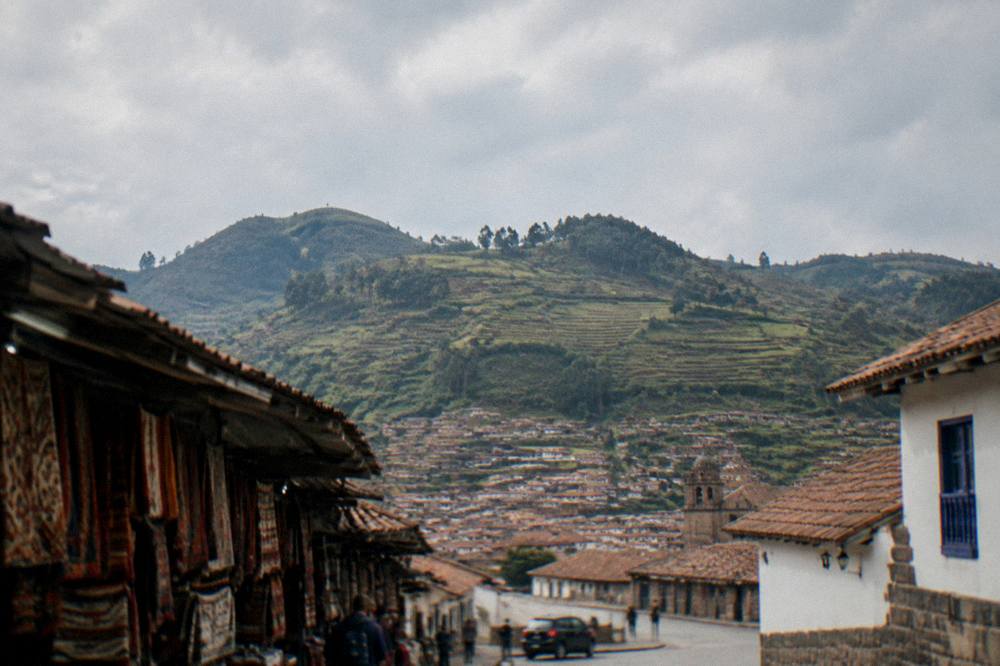
The elevations around the market explain why pacing matters. The city sits at 3,335 m at the Plaza de Armas, the hills above it climb higher, and the Sacred Valley towns drop away to the northwest.
| Place | Elevation |
|---|---|
| Plaza de Armas, Cusco | 3,335 m |
| Cusco airport | 3,310 m |
| Saqsaywaman | 3,701 m |
| Moray | 3,385 m |
| Maras | 3,300 m |
| Pisac | 2,972 m |
| Ollantaytambo | 2,792 m |
| Machu Picchu citadel | 2,430 m |
| Aguas Calientes, Machu Picchu Pueblo | about 2,040 m |
From the market, the classic extension is the Sacred Valley, and its main sites are covered in depth on this site: Pisac in the Sacred Valley, Ollantaytambo further down the valley, Moray's circular terraces and the Maras salt mines, with Chinchero on the road between them. Closer to home, Saqsaywaman on the hills above the city is the nearest of the big Inca sites and sits on the Boleto's Circuit I. All of these sit lower than the city except Saqsaywaman, which is part of why valley days double as acclimatisation days.
For a bigger day out, the Humantay Lake tour on the roster runs to a turquoise highland lake with breakfast and a buffet lunch included, and the product card prints the current price and rating. The lake sits at about 4,200 m, so it belongs later in a trip rather than on arrival day.
The trekking option that pairs a market day with the region's headline hike is the two-day Short Inca Trail to Machu Picchu, which the roster carries with a Vistadome train return and a hotel stay. The Inca Trail permits that cover it are sold only through licensed agencies, with 500 people a day on the trail including porters and guides, and the trail closes every February; the product card holds the live details and dates.
Common Questions About San Pedro Market Cusco
The questions below cover the practical basics of a San Pedro Market visit: whether it is worth the time, what a meal costs, what to buy, food safety and opening days. Each answer draws on the figures and reported ranges in this guide, and where no figure exists for Cusco's market, the answer says so plainly rather than guessing.
Is San Pedro Market Cusco worth visiting?
For anyone interested in food, everyday Andean culture or low-cost eating, yes. The market is the city's central food hall, free of the formality of museums and ruins, and it shows the region's produce, dishes and trade in one covered space. Travellers whose interests run only to archaeology can treat it as a lunch stop on the old-quarter loop.
How much does a meal cost at San Pedro Market Cusco?
A menu del dia, the fixed lunch served at market food counters, is reported at about S/ 8 to 15, and a cup of coca tea at about S/ 2 to 5. These are reported ranges from operators and local guides, not official tariffs; individual stalls set their own prices, and juice counters price by the blend.
What should I buy at San Pedro Market in Cusco?
Produce that travels well, such as grains, cacao, chocolate and coffee, plus the craft and textile section's knitwear, scarves, blankets, bags and hats. For weaving demonstrated by the makers themselves, the Awana Kancha centre on the road out of the city is the established place, and the ChocoMuseo workshop covers chocolate in depth.
Is the food at San Pedro Market Cusco safe?
The CDC's guidance for Peru advises avoiding contaminated water and drinking bottled, boiled or treated water, and that applies to market drinks as much as anywhere: juices blended with treated water and hot food straight from the counter are the standard reading of that advice. Anyone with specific health concerns should raise them with a doctor before travel, as the CDC itself advises for high-altitude destinations.
What are the opening hours of San Pedro Market Cusco?
No verified timetable for the market is published by this site's sources, and stall hours vary by stall, so the practical answer is to ask locally or at your hotel on the day. As a working city market it operates around the city's daily rhythm rather than a posted schedule.
Can you visit San Pedro Market on a tour from Cusco?
Yes. The roster on this site carries a central market food walking tour, a small-group street food walk limited to ten people or fewer, and a cooking class that pairs a guided San Pedro Market visit with a hands-on class. The product cards print the live prices, ratings and durations for each.