Moray
Moray is a set of vast circular terraces cut into a high plateau in the Sacred Valley of the Incas, about an hour's drive from Cusco, and it is one of the four archaeological sites on Circuit III of the Boleto Turistico.
Short answer
Moray is an Inca archaeological site of concentric circular terraces in the Sacred Valley, at 3,385 m, covered by Boleto Turistico Circuit III (S/ 70 for foreign tourists) or the S/ 130 integral ticket. It is reached on a Sacred Valley day trip from Cusco, usually paired with the Maras salt mines.
Moray sits on a high plateau in the Sacred Valley of the Incas, in the Cusco region of southern Peru, at 3,385 m, a few kilometres from the town of Maras and roughly an hour's road travel from the city of Cusco. The site is a group of deep, circular terraced depressions, cut and walled in stone, whose concentric rings are among the most photographed Inca structures in Peru. The Ministry of Culture counts Moray among the sixteen sites on the COSITUC Boleto Turistico, on Circuit III alongside Pisac, Ollantaytambo and Chinchero, which is the practical fact that shapes most visits. The MINCETUR open dataset recorded 773,916 visits to Moray in 2025, which places it among the most-visited archaeological sites in the entire Cusco department.
For planning purposes Moray is a stop on a Sacred Valley circuit rather than a standalone destination. The terraces lie a short drive from the Maras salt mines, whose evaporation pans are not on the Boleto and carry their own community fee, and the two are almost always visited together. This page lays out what the site is, what the ticket costs, how to reach it, and what the surrounding valley offers, in the words of the official sources rather than anyone's travel diary.
What Is Moray And Where Is It In The Sacred Valley?
Moray is an Inca archaeological complex of circular, concentric agricultural terraces built into natural depressions on a plateau at 3,385 m, near the town of Maras in the Sacred Valley of the Incas, in the Cusco region of Peru. The site is administered as one of the sixteen Boleto Turistico locations and sits on Circuit III, the Sacred Valley circuit, together with Pisac, Ollantaytambo and Chinchero.
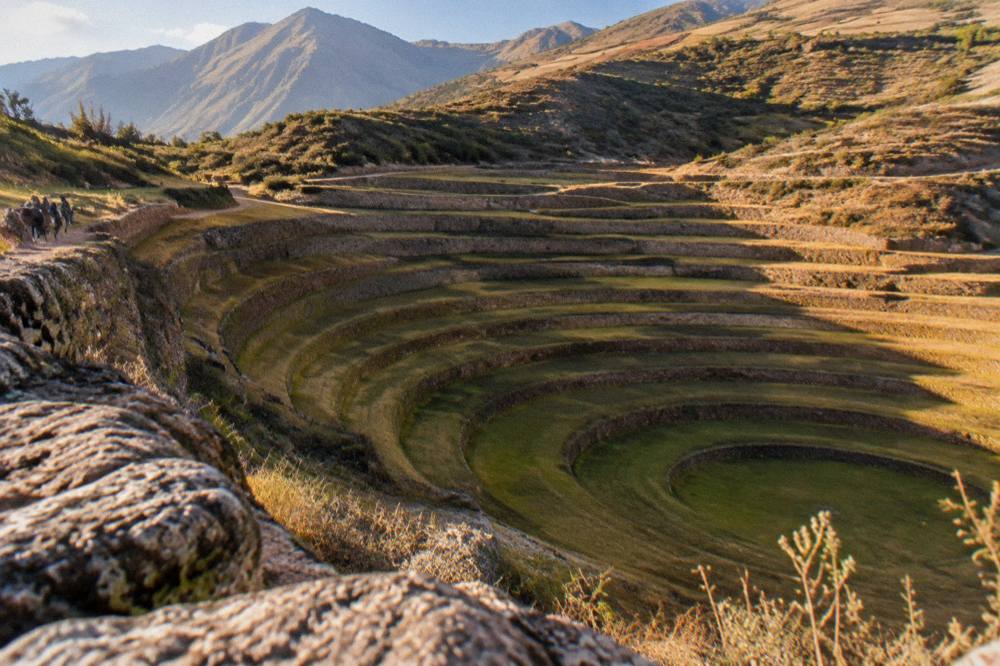
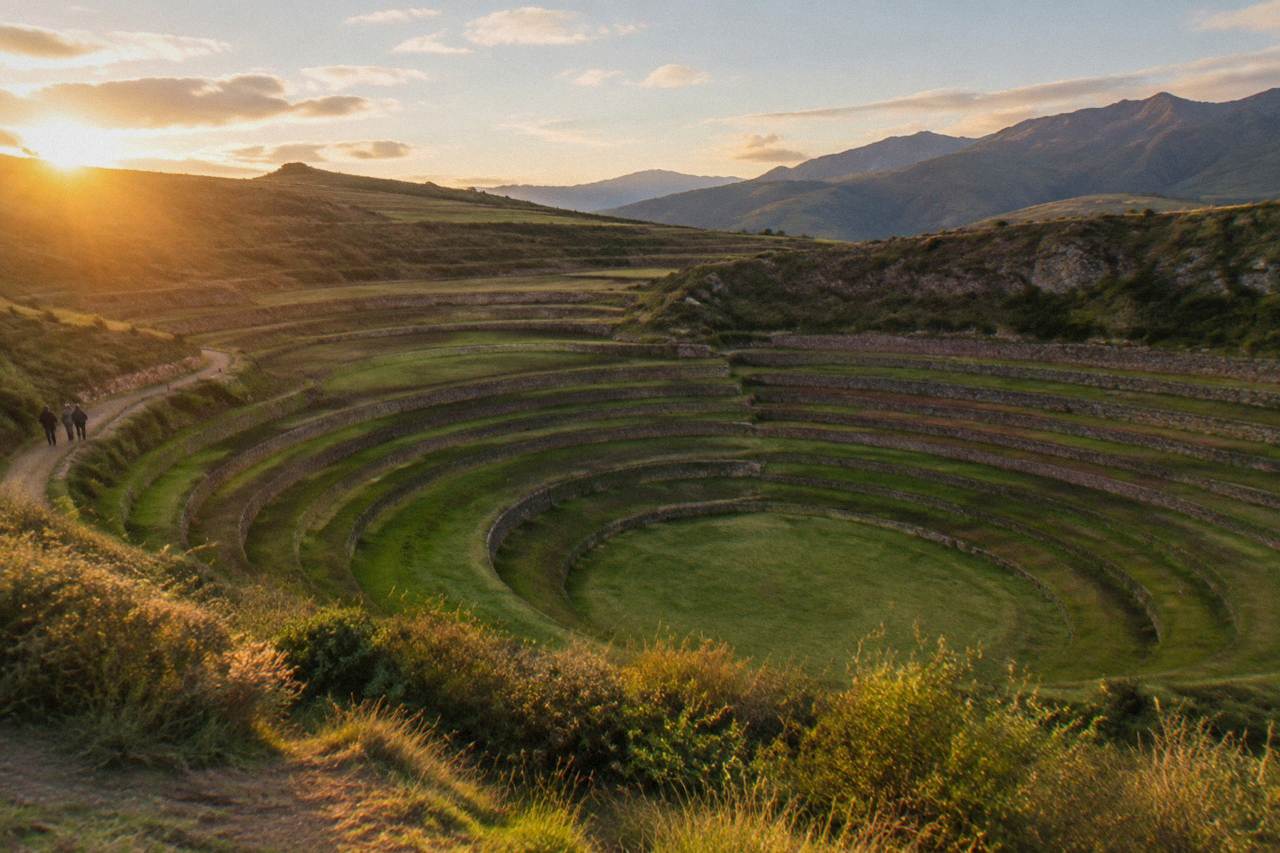
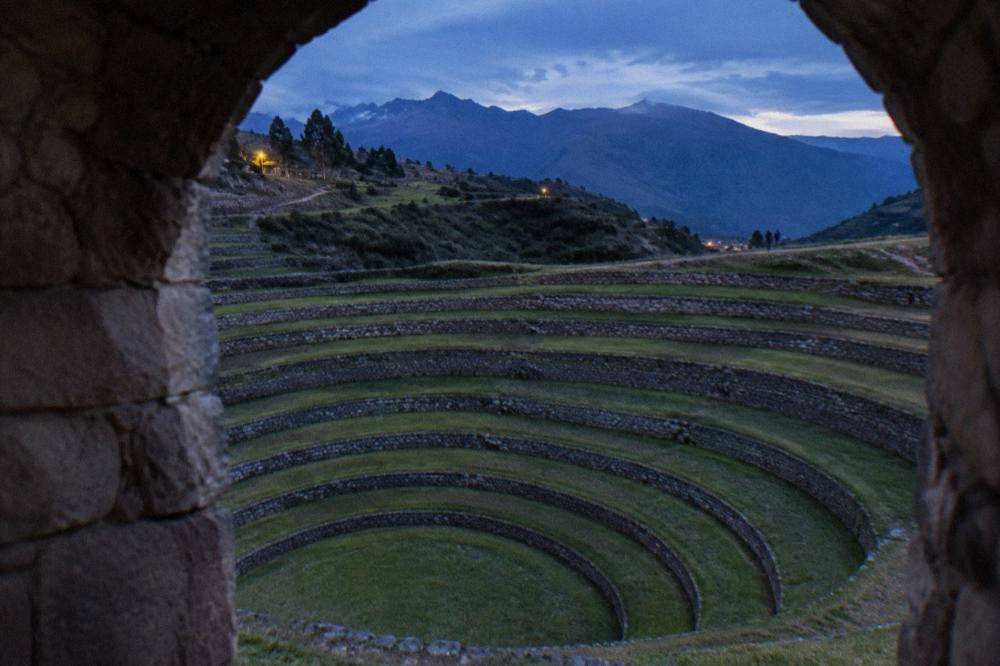
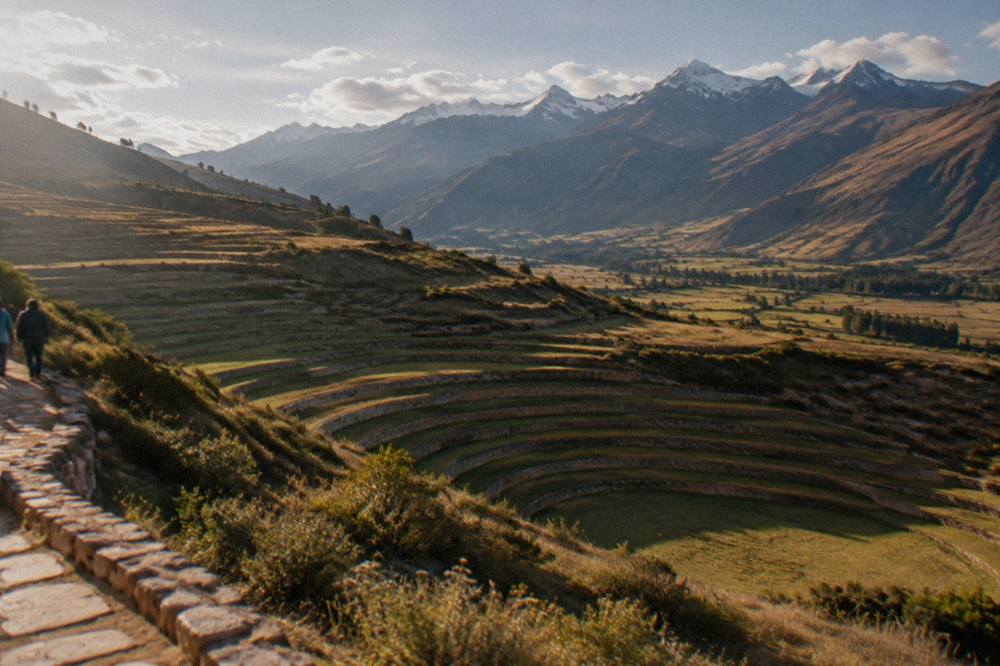
The visual signature of Moray is its geometry. Where most Inca agricultural works follow hillsides in long lateral benches, the terraces at Moray descend in nested rings, several deep, so that from the rim a visitor looks down into a green amphitheatre of stone retaining walls. The site holds more than one of these circular structures, of differing depth and diameter, set into the rolling grassland of the pampa. Quechua and Spanish names in the area carry accents in body prose, but the site's own name is written plainly: Moray.
What the rings were for is a question the sources treat carefully. PromPeru and the Ministry of Culture describe Moray as an Inca agricultural site, and the common interpretation, repeated across official tourism pages, is that the terraces served as a place where crops were grown at different conditions across the rings, with temperature and exposure varying between the top and the bottom of each depression. No source in the verified pack assigns a construction date, a builder or a ruler to Moray, and this page does not either. What the sources do support is the physical description: deep circular terracing, finely built stone walls, and a setting on a windswept plateau at altitude.
The altitude matters for the visit itself. At 3,385 m, Moray stands higher than Cusco's Plaza de Armas at 3,335 m, though the difference is small enough that nobody treats Moray as a separate acclimatisation challenge. The CDC Yellow Book names Cusco as a rapid-ascent high-altitude destination and advises graded ascent where feasible; a day in the Sacred Valley, sleeping in Cusco, fits the pattern the CDC describes. The site is open grassland with little shade, so sun protection and layers matter more than fitness.
How Much Does Moray Cost, And Is It On The Boleto Turistico?
Yes, Moray is on the Boleto Turistico, on Circuit III, the Sacred Valley circuit. A foreign adult pays S/ 130 for the integral ticket, valid 10 days, or S/ 70 for the Circuit III partial ticket, reported as valid for 2 days. COSITUC sells the ticket in person only, at the counter on Av. El Sol 103 in Cusco, daily 07:30 to 18:00, and at most included sites. There is no online sale.
The COSITUC tarifario, the official price list read at cosituc.gob.pe, sets the integral ticket for foreign adults at S/ 130, about US$38, with foreign students paying S/ 70. The three partial circuits each cost S/ 70 for foreign tourists, about US$20. Circuit I covers Saqsayhuaman, Q'enqo, Puka Pukara and Tambomachay above the city; Circuit II covers the Cusco museums and the southern sites of Tipon and Pikillaqta; Circuit III covers Pisac, Ollantaytambo, Chinchero and Moray. Validity for the partials is reported as 1 to 2 days, with Circuit III on the 2-day side, and the COSITUC FAQ notes that validity starts on the day of purchase and that covering all sixteen sites needs a minimum of three days.
One point of confusion is worth settling directly: Machu Picchu is not on the Boleto in any form. The Ministry of Culture sells Machu Picchu entry on its own ticket platform, and the Boleto's Circuit III has nothing to do with Machu Picchu's own three-circuit system introduced in June 2024. A visitor holding a Circuit III partial can see Moray, Pisac, Ollantaytambo and Chinchero, and nothing else.
Children enter free to age 9, and ages 10 to 17 pay the student price with ID. Only students receive a discount; the COSITUC FAQ states plainly that there is no teacher-card or youth-card reduction. The site's own page on the Boleto Turistico carries the full breakdown of all sixteen sites and where to buy.
| Boleto Turistico option | Price, foreign adult | Validity | Sites included |
|---|---|---|---|
| Integral ticket | S/ 130 (about US$38) | 10 days | All 16 sites |
| Circuit I partial | S/ 70 (about US$20) | 1 day | Saqsayhuaman, Q'enqo, Puka Pukara, Tambomachay |
| Circuit II partial | S/ 70 (about US$20) | 2 days | Cusco museums, Qorikancha site museum, Tipon, Pikillaqta |
| Circuit III partial | S/ 70 (about US$20) | 2 days | Pisac, Ollantaytambo, Chinchero, Moray |
The Boleto is not the only cash that changes hands in the valley. The Maras salt mines, the stop most often paired with Moray, are not among the sixteen Boleto sites: operators reported a fee of S/ 15 to S/ 20, about US$4 to US$6, in 2026, paid in cash at the entrance. That is the standard pairing cost to budget for a Moray day.
How Do You Get To Moray From Cusco?
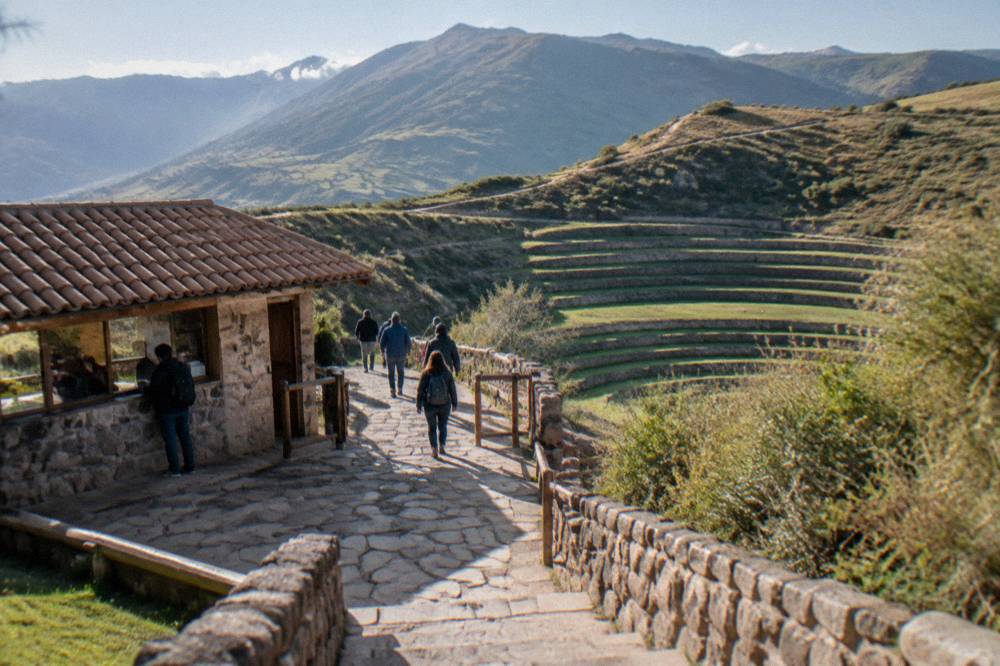
Moray is reached by road from Cusco, through the town of Maras in the Sacred Valley; there is no train and no river route. Many visitors arrive on a Sacred Valley day tour, and independent travellers use the same road by colectivo or private transport. A new 8 km asphalt road linking Maras to Moray was handed over in late December 2025, smoothing the final stretch.
The road from Cusco climbs over the lip of the valley toward Chinchero and drops toward Maras, a small highland town at 3,300 m that gives the district its name and serves as the junction for both Moray and the salt mines. The verified pack holds no journey time for the Cusco to Moray drive, so this page gives none; what the sources do record is the December 2025 handover of the 8 km Maras to Moray asphalt road, reported by regional infrastructure news, which replaced the rougher track that earlier guidebooks describe.
Independent travel in the valley runs on colectivos, the shared minibuses that locals use between Cusco, Urubamba and the valley towns. The pack holds reported fare ranges for colectivos to Pisac and Ollantaytambo but none specifically for a Maras or Moray leg, and fares are agreed before the ride, so the honest instruction is to agree the fare at the point of departure. Taxis and private drivers are also available, and the roster carries a private airport transfer product for Cusco arrivals, though for valley days many travelers simply book a tour.
That is the practical reality of Moray access: the site sits on a plateau between towns, with no accommodation at the terraces themselves, so nearly every visit is a day movement from Cusco or from a Sacred Valley base such as Urubamba or Ollantaytambo. The site's own Sacred Valley guide and the getting around Cusco page cover the transport web in detail.
For travellers who would rather not negotiate colectivos at altitude, the featured Sacred Valley day trip on this site's roster covers Moray and the salt mines with a buffet lunch included, and the operator's live listing carries the current price, rating and departure details.
What Do You Actually See At Moray?
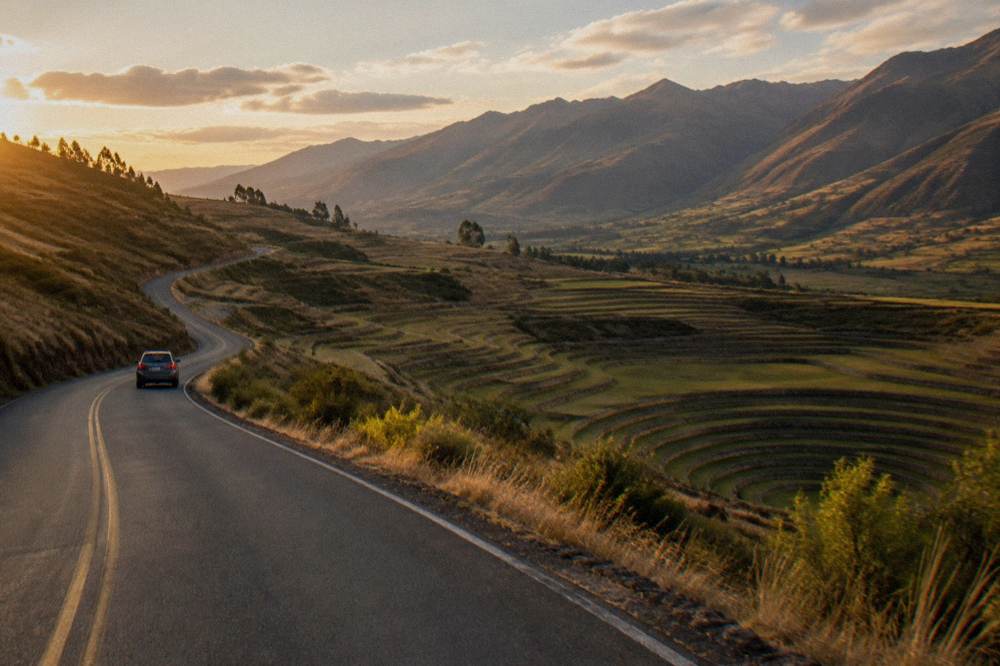
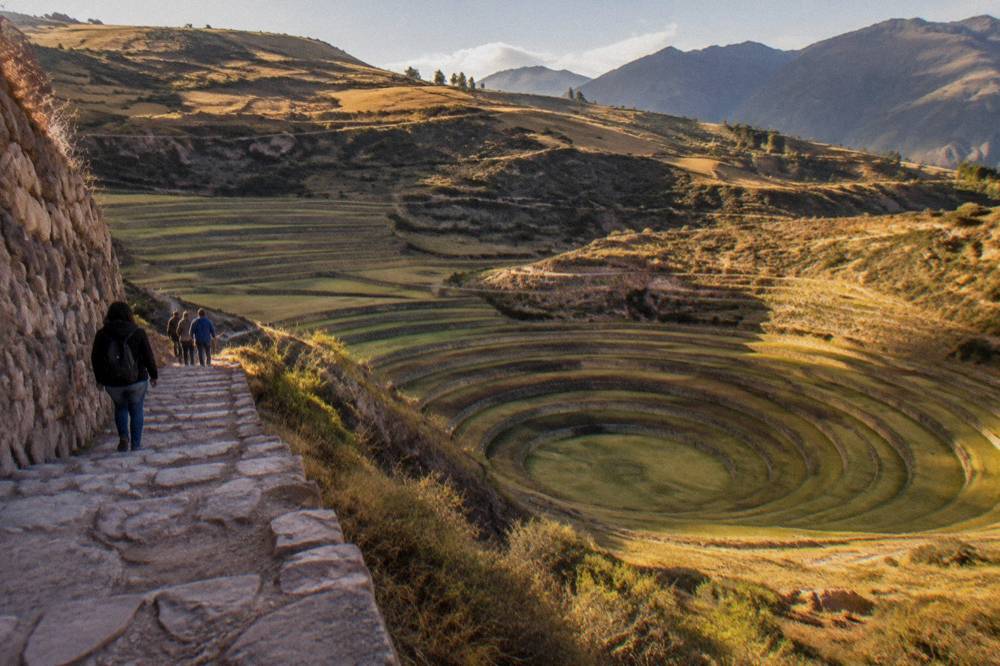
Visitors see several enormous circular terraced depressions, the deepest dropping tens of metres into the plateau, with stone retaining walls holding stepped earth benches on every ring, connected by stone steps set into the walls. The site is an open grassland pampa at 3,385 m, with viewing paths around the rims and, on the largest depression, access along the terraces themselves.
The first impression is scale from above. Arriving visitors reach the rim of the main depression and look down into a bowl of green rings, each terrace a flat growing surface held by a dressed stone wall, the whole pattern repeating inward like a contour map made of earth. The depressions at Moray are natural sink features that the Inca builders reshaped and walled, which is why the site reads as architecture and landscape at once.
Walking the site takes in the differences between the circles. The largest and deepest structure holds the classic nested rings; a second depression sits nearby with its own terrace sequence; a third, smaller and less restored, shows the rawer state of the works. Stone staircases are built into the terrace walls at intervals, the same vertical-slot stair design seen at other Inca sites in the region, allowing movement between levels without walking on the growing surfaces.
What the terraces meant to their builders is where restraint is needed. The widely repeated interpretation, that the rings created microclimates and served as an agricultural research station where crops were tested at different temperatures, appears in official tourism descriptions of the site as an interpretation, not a documented fact. No source in the verified pack dates the terraces, names a builder or records what was grown. The honest framing, and the one this site uses, is that Moray is an Inca agricultural complex whose precise function is interpreted rather than documented, and that the terraces' varying depth and exposure are visible facts any visitor can check.
Practical notes for the visit: the site is high, exposed grassland. The WMO station record for Cusco shows mean daily maxima between 18.8 and 20.9 C all year, but nights drop near freezing in the June to August dry season, and the midday sun at 3,385 m is intense. Sunscreen, a hat, water and layers are the standard kit, the same advice that applies across the Cusco altitude pages.
When Is The Best Time Of Year To Visit Moray?
The dry season, roughly May to September, is the clearest and most reliable time to see Moray, when the Cusco region receives only a few millimetres of rain per month. December to March carries 71.9 percent of the year's 707.8 mm of rain at the WMO and SENAMHI station for Cuzco, so wet-season visits trade thinner crowds for a real chance of cloud, rain and slippery terrace paths.
The climate record behind that answer comes from the World Weather Information Service station for Cuzco, supplied by SENAMHI, Peru's national weather service, a historical normal rather than a recent averaging period. The pattern is unambiguous: June, July and August bring 1.5, 4.0 and 8.6 mm of rain respectively, while January alone brings 145.3 mm. The dry months are also the cold ones, with mean minimums of 0.3 C in June and 0.1 C in July, frost nights common, and mean maximums still reaching 19.5 and 19.1 C. A Moray visit in the dry season is a cold start, a warm midday and a bitter blue sky. The rest of the planning pages sit on Things To Do In Cusco Peru.
The wet season is not a write-off. Mean maximums stay near 19 C even in January, rain falls in bursts rather than all day, and the valley is at its greenest. The trade-off is the state of the paths: the terrace steps and rim trails are unpaved earth and stone, and rain makes them slick. The MINCETUR visitor data for the region's flagship site shows the crowd pattern clearly: at Machu Picchu, October 2025 drew 154,105 visitors against February's 79,806, and Moray, as a circuit stop, shares that seasonal rhythm in gentler form.
| Month | Mean max C | Mean min C | Rain mm |
|---|---|---|---|
| Jan | 18.9 | 6.6 | 145.3 |
| Apr | 19.7 | 4.9 | 43.2 |
| Jun | 19.5 | 0.3 | 1.5 |
| Jul | 19.1 | 0.1 | 4.0 |
| Aug | 19.8 | 1.6 | 8.6 |
| Oct | 20.9 | 5.5 | 39.4 |
The table above is a selection from the full twelve-month set on the Cusco weather by month page. Whichever season a visitor picks, the timing advice is the same as for the rest of the valley: mornings are calmer and clearer, and exposed sites like Moray are best seen before the afternoon cloud builds.
What Else Can You Combine With Moray In One Day?
The standard combination is Moray plus the Maras salt mines, two sites a few kilometres apart on the same road, usually visited with Chinchero or Pisac and Ollantaytambo as a full Sacred Valley circuit. All of the archaeological stops except the salt mines are on Boleto Circuit III, so one S/ 70 partial ticket covers the ruins for the day while the salt mines take a separate cash fee.
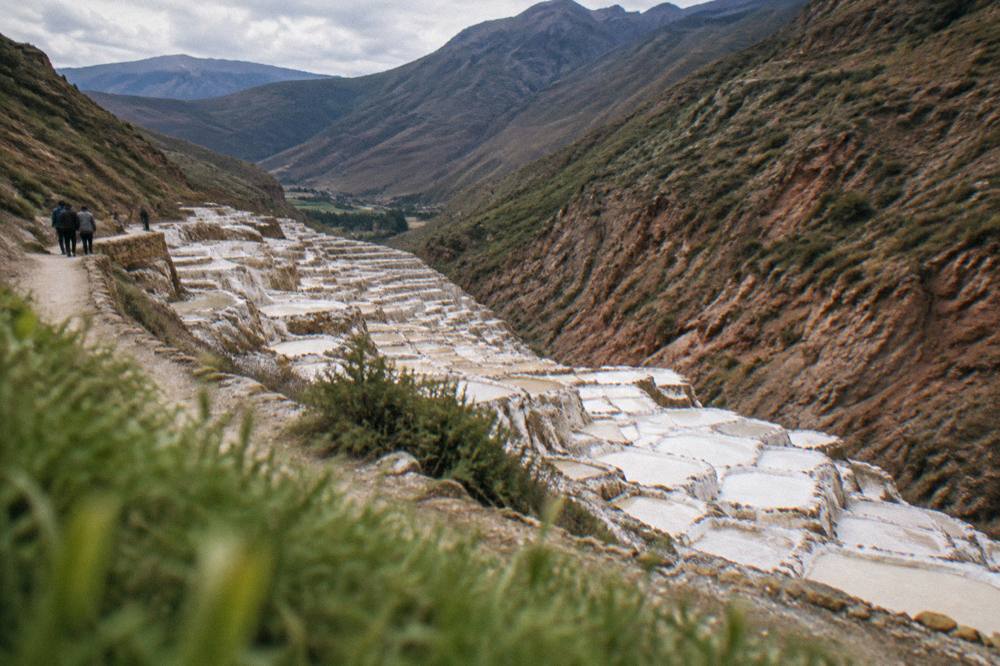
The salt mines of Maras are the natural pairing. Thousands of evaporation pans terraced down a hillside have been worked since before the Inca period, and the site is a working community enterprise, not a ruin, which is why it sits outside the Boleto system with its own reported fee of S/ 15 to S/ 20 in cash. The Maras salt mines page on this site covers the pans in detail. Between the two sites the road now runs on the asphalt handed over in December 2025, so the pairing is a short hop rather than the expedition older accounts describe.
Beyond the pairing, the Circuit III logic takes over. Chinchero, with its colonial church on Inca foundations and its weaving traditions, sits on the Cusco side of the loop; Pisac, with its hilltop terraces and its famous market town below, anchors the eastern valley; Ollantaytambo, the town where the Inca street plan still functions, sits at the western end. A one-day Circuit III run from Cusco typically strings Chinchero, Moray, the salt mines and either Pisac or Ollantaytambo, and the Sacred Valley in one day page maps the sequencing question.
| Sacred Valley stop | Elevation | Ticket |
|---|---|---|
| Moray | 3,385 m | Boleto Circuit III |
| Maras | 3,300 m | Salt mines fee, S/ 15 to S/ 20 reported |
| Pisac | 2,972 m | Boleto Circuit III |
| Urubamba | 2,870 m | No entry fee |
| Ollantaytambo | 2,792 m | Boleto Circuit III |
The elevation column in that table is more than trivia: the circuit runs downhill from the Moray plateau to the valley floor, and the CDC's graded-ascent logic works in reverse here, with the valley towns sitting lower than Cusco. Many itineraries, including the acclimatisation day plan on this site, deliberately place a Sacred Valley day early in a Cusco stay for exactly that reason, following the descent-to-sleep principle the CDC Yellow Book describes for rapid-ascent destinations.
Is Moray Worth Visiting Without A Tour?
Yes, Moray can be visited independently with a Boleto ticket and arranged transport, and the site itself needs no guide to appreciate its geometry. The trade-off is logistics: the terraces sit between towns with no direct colectivo spine, so independent visitors piece together transport to Maras and onward, while tours bundle the driving, the ticket stops and the salt mines fee into one movement.
The independent route suits confident travellers who want time at the rim without a schedule. Buy the Circuit III partial in Cusco at the Av. El Sol counter, agree fares for the valley legs, and expect the day to be a sequence of negotiations. The pack holds no fare for a dedicated Cusco to Moray service, because the honest position is that the trip is usually assembled from Cusco to Maras and Maras to the sites, with fares agreed at departure.
The guided route suits everyone else, and the roster on this site carries strong options. The featured Sacred Valley and salt mines day trip with buffet lunch is the direct match for this page: it covers Moray and the pans with meals and transport handled. Travellers combining the valley with Machu Picchu in a single movement often choose a two-day Cusco to Sacred Valley and Machu Picchu by train itinerary, which uses the valley day as the first half. And visitors who want a wilder day after the ruins can look at the Ausangate seven lakes trek with breakfast and lunch, a high-altitude hike into a completely different Andean landscape.
The question of a guide at Moray itself has a clean answer: unlike Machu Picchu, where the current Ministry of Culture rule makes a guide recommended rather than mandatory, Moray has no guide requirement at all. Interpretation at the site comes down to signage and whatever a visitor brings with them, which is one reason many travellers prefer a guided day here even when they go independently elsewhere.
How Popular Is Moray Compared With The Other Cusco Sites?
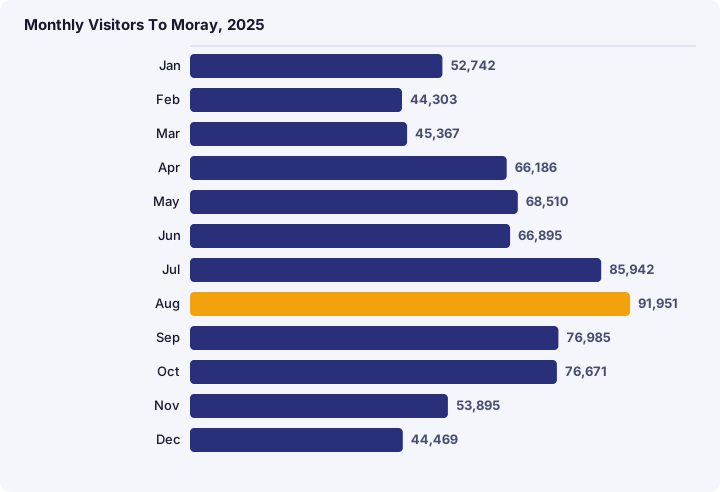
Moray recorded 773,916 visits in 2025 according to the MINCETUR open dataset, making it one of the busiest archaeological sites in the Cusco department, ahead of Pisac at 560,578 but well behind the Machu Picchu citadel at 1,479,506 and the Saqsayhuaman explanada at 944,008. The figures count site entries, not unique visitors.
The dataset, published by Peru's Ministry of Foreign Trade and Tourism and last cut in April 2026 with December 2025 as the final month, is the only sourced ranking tool this site uses. It shows the valley's pulling power plainly: Ollantaytambo's archaeological park recorded 891,526 visits in 2025, Moray 773,916, Pisac 560,578, and the train services themselves, Inca Rail and PeruRail, recorded 855,718 and 698,742 passenger counts respectively. The department total across all 29 recorded sites reached 10,704,938 entries in 2025, up from 10,288,103 in 2024.
| Cusco site, 2025 visits | Entries |
|---|---|
| Machu Picchu Historic Sanctuary (whole sanctuary) | 1,542,350 |
| Machu Picchu Inca city | 1,479,506 |
| Saqsayhuaman explanada | 944,008 |
| Ollantaytambo archaeological park | 891,526 |
| Moray | 773,916 |
| Pisac | 560,578 |
Two cautions travel with those numbers. First, the counting units differ: the sanctuary figure for Machu Picchu is larger than the citadel figure because it covers a wider area, and the Saqsayhuaman explanada counts a free open space, not a ticketed interior. Second, none of these are unique people: a visitor who tours the valley for three days appears in several rows. Used honestly, the data says that Moray is firmly on the mainstream circuit, busy by any regional standard, and that the crowd experience is a function of season and hour more than of the site's fame.
Common Questions About Moray
Is Moray included in the Boleto Turistico?
Yes. Moray is one of the sixteen Boleto sites, on Circuit III, the Sacred Valley circuit, together with Pisac, Ollantaytambo and Chinchero. A foreign adult pays S/ 70 for the Circuit III partial ticket, reported as valid for 2 days, or S/ 130 for the integral ticket valid 10 days. COSITUC sells the Boleto in person only, at the Av. El Sol 103 counter in Cusco, daily 07:30 to 18:00, and at most included sites.
How far is Moray from Cusco?
Moray lies in the Sacred Valley near the town of Maras, reached by road from Cusco via the Chinchero side of the valley. The verified sources hold no journey time for the exact Cusco to Moray drive, so this site prints none. The final 8 km from Maras to the terraces runs on an asphalt road handed over in late December 2025.
Can you visit Moray and the Maras salt mines on the same day?
Yes, and many do. The two sites sit a few kilometres apart on the same road, and the standard Sacred Valley day trip pairs them, often with Chinchero and either Pisac or Ollantaytambo. The terraces are on the Boleto; the salt mines are not, and charge a separate community fee reported at S/ 15 to S/ 20 in cash.
What was Moray used for?
Moray is an Inca agricultural complex of concentric circular terraces. Official tourism descriptions present the interpretation that the rings created varying growing conditions across their depth, but no verified source assigns the site a construction date, a builder or a documented function, so this site treats the microclimate reading as an interpretation rather than a fact.
Is Moray higher than Cusco?
Slightly, yes. Moray stands at 3,385 m and Cusco's Plaza de Armas at 3,335 m. Both are far higher than Machu Picchu's citadel at 2,430 m, which is why Sacred Valley days are often placed early in a Cusco stay, following the graded-ascent advice in the CDC Yellow Book.
Do you need a guide at Moray?
No source in the verified pack sets any guide requirement at Moray. For comparison, even at Machu Picchu the Ministry of Culture's current rule, rewritten in September 2026, makes a guide recommended rather than mandatory. Visitors who want interpretation at the terraces generally take a guided Sacred Valley day trip.
Moray rewards exactly the kind of visit the valley makes easy: a morning on the plateau among the rings, a short hop to the salt pans, and a slow descent through the Circuit III towns, with the Boleto bought in person in Cusco the day before. The terraces ask nothing of a visitor but attention, and the sources that describe them, from COSITUC's tarifario to MINCETUR's visitor counts, agree on the essentials: a high, circular, working landscape an hour into the Andes above the old Inca capital. Travellers planning the wider region can start from the Sacred Valley overview or the three days in Cusco itinerary, and Things To Do In Cusco Peru carries the full set of valley pages for the rest of the circuit.