Adventure Activities In Cusco
Cusco sits at 3,335 m in the Andes of southern Peru, and the country around it is built for adventure: tandem paragliding over the Sacred Valley, day hikes to turquoise lakes at about 4,200 m, rafting on the Urubamba River and multi-day treks that finish at Machu Picchu.
Short answer
The main adventure activities around Cusco are tandem paragliding in the Sacred Valley, day hikes to Humantay Lake, Rainbow Mountain and Palccoyo, rafting and zip lining on the Urubamba River, horseback riding to Inca sites, quad biking to Maras and Moray, and multi-day treks such as the Inca Trail, Salkantay and Lares routes. Season matters: the dry stretch from May to September suits almost all of them.
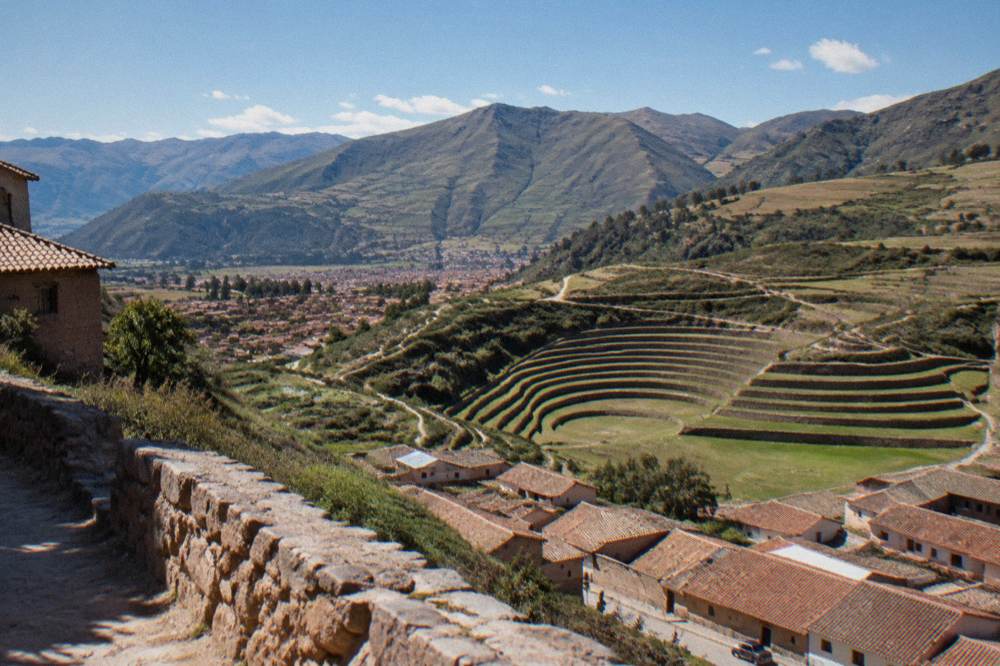
Cusco, the historic city in the Andes of southern Peru, sits at 3,335 m on the Plaza de Armas, and the geography around it turns almost every direction into an adventure. The Sacred Valley drops away to the northwest with towns such as Pisac at 2,972 m, Urubamba at 2,870 m and Ollantaytambo at 2,792 m, giving paragliders and rafters a lower, warmer stage than the city itself. To the south and west the ground climbs instead: Humantay Lake at about 4,200 m, the Palccoyo viewpoint at 4,900 m and Rainbow Mountain, Vinicunca, at about 5,000 m. This guide lays out what each adventure around Cusco involves, what the verified entry fees and altitudes are, and how the dry and wet seasons change the plan.
What Adventure Activities Can You Do Around Cusco?
The adventure menu around Cusco covers tandem paragliding over the Sacred Valley, day hikes to Humantay Lake, Rainbow Mountain and Palccoyo, rafting and zip lining on the Urubamba River, horseback riding to Inca sites such as the Temple of the Moon, quad biking to Maras and Moray, and multi-day treks including the Inca Trail, Salkantay, Lares and the Inca Jungle Trail. Most day adventures leave from Cusco itself and return the same evening.
The range is unusual for a single base city. In one week a visitor based in Cusco can fly on a tandem paraglider above Sacred Valley farmland, hike to a glacial lake, ride a horse past Inca ruins and paddle a river, all without changing hotels. The variety exists because Cusco sits between two very different landscapes: the deep, cultivated valley to the northwest and the high puna and glaciated peaks to the south, where Ausangate and the seven lakes trek sit.
The table below maps the main adventure families to their area and what each one physically involves. Product details such as prices and durations live on each operator's live listing, which the cards further down this page render from verified data.
| Adventure type | Area used | What it involves |
|---|---|---|
| Tandem paragliding | Sacred Valley | Flying with an instructor above valley farmland and terraces |
| Mountain day hikes | Humantay, Vinicunca, Palccoyo, Ausangate, Waqrapukara | Early departure, high-altitude walking, return to Cusco |
| Rafting and zip line | Urubamba River, Sacred Valley | White water sections plus canopy zip line |
| Horseback riding | Cusco outskirts, Temple of the Moon | Riding to Inca-era sites above the city |
| Quad biking | Maras and Moray | ATV riding on valley tracks between the salt mines and Moray |
| Multi-day treks | Inca Trail, Salkantay, Lares, Inca Jungle | Camping or lodge routes ending at Machu Picchu |
Two of these, the paragliding flight and the Humantay hike, pair well because they use opposite ends of the altitude range: the flight launches from valley ground well below Cusco, while Humantay climbs above it. The seven lakes Ausangate trek and the Waqrapukara trip are the quieter options, with fewer visitors on the trails than the marquee names.
Where Does Cusco Paragliding Take Place, And What Is The Flight Like?
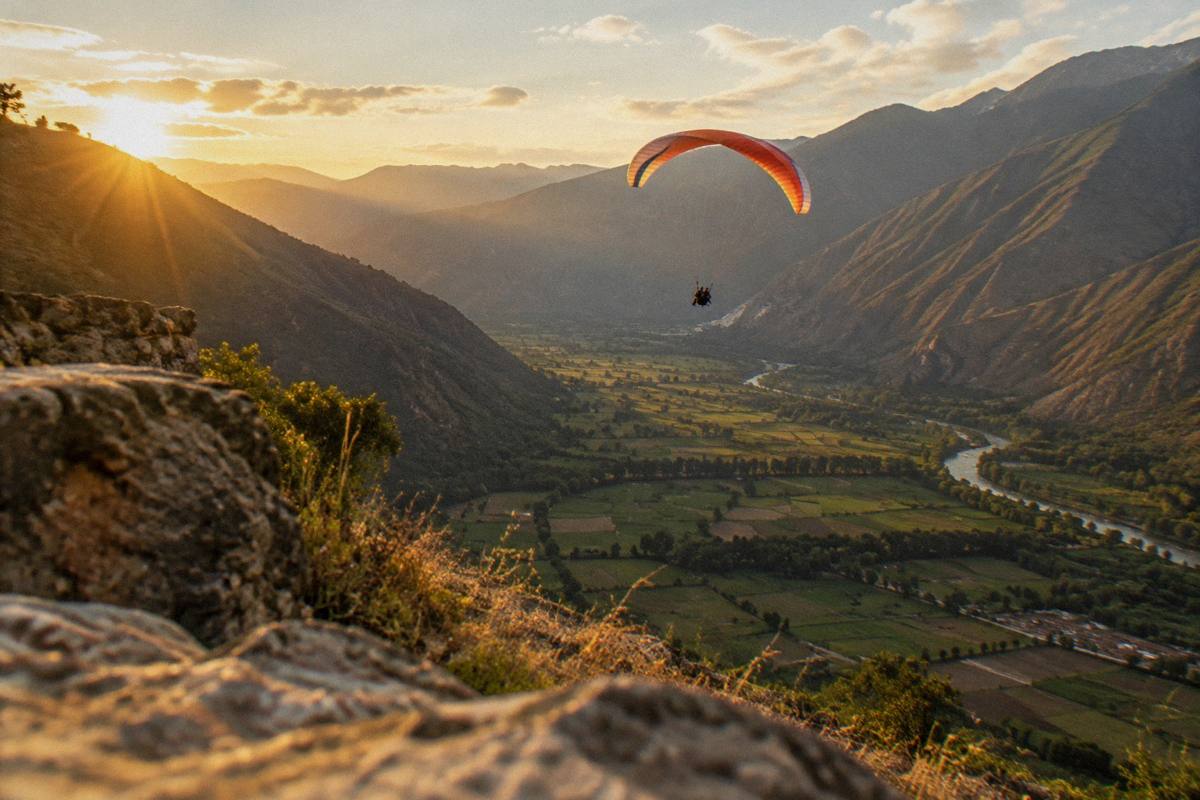
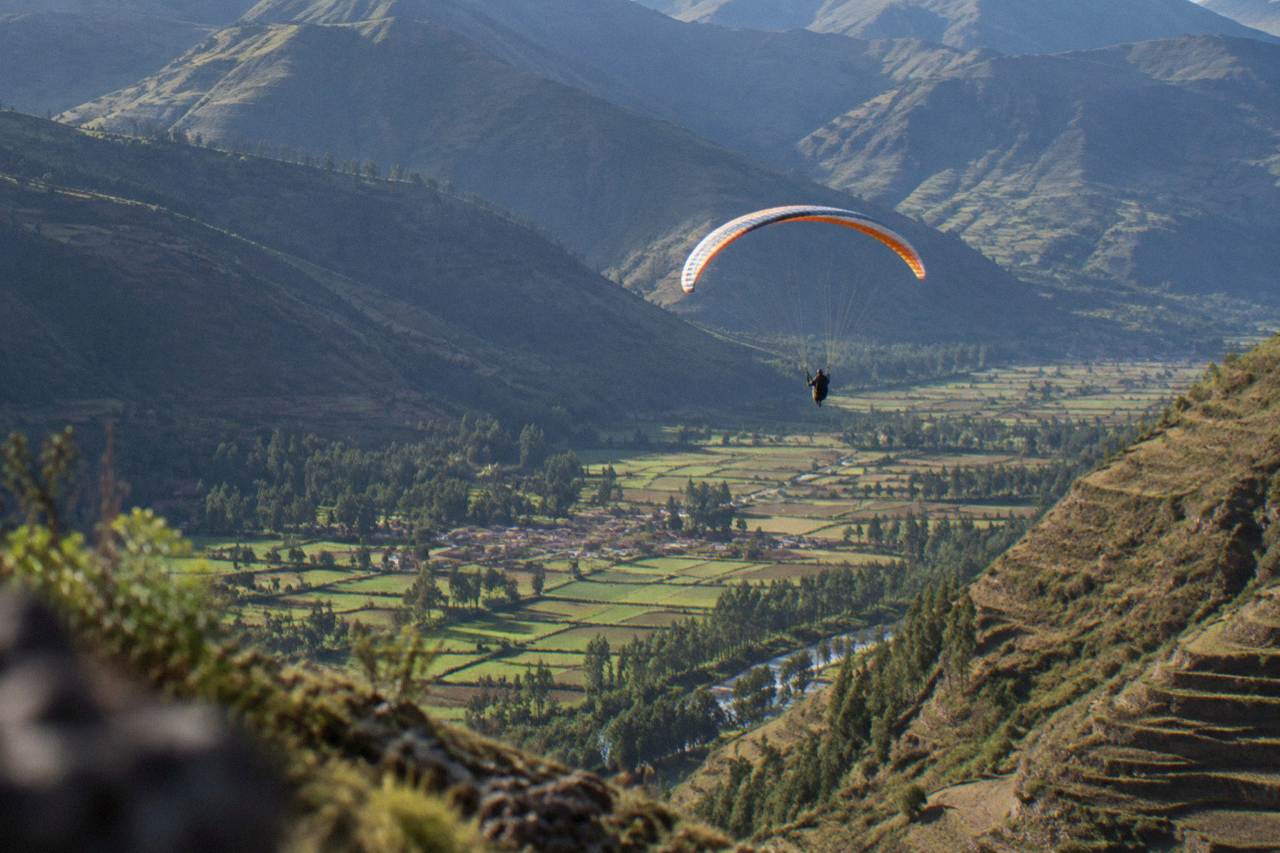
Cusco paragliding is tandem flying in the Sacred Valley of the Incas, not off the hills above the city itself: the operator's listing places the activity in the Sacred Valley, with specialised instructors flying each passenger. The listing describes a flight over the Sacred Valley of the Incas by paragliding with specialised instructors, booked as a guided adventure from Cusco.
The distinction matters for two reasons. First, the air in the valley is warmer and more stable than the thin air over Cusco at 3,335 m, which is why the valley, not the city, hosts the flights. Second, the Sacred Valley's geography, a broad flat floor with terraced slopes rising on both sides, gives pilots a readable landscape for launching and landing. The roster's paragliding product carries a rating of 4.69 on its own listing, and the card below shows the current from-price.
The flight is booked as a full guided outing from Cusco rather than a show-up-on-the-day activity, and the operator's listing states that specialised instructors handle the flying. Anyone weighing the decision can check dates and free-cancellation terms on the operator's live listing before committing: Check availability.
Is Paragliding Near Cusco Safe?
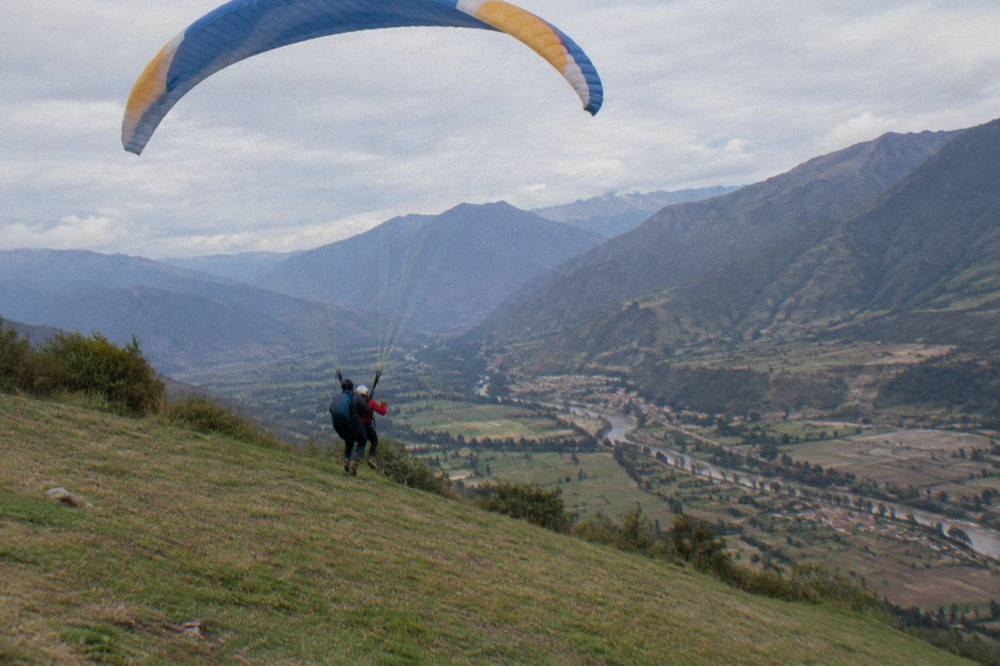
The roster's paragliding product is flown by specialised instructors on tandem flights, which is the standard safety model for the activity: the passenger rides with a qualified pilot rather than flying solo. Peru's national safety context is that Cusco city, the Sacred Valley, the Inca Trail and Machu Picchu sit outside the areas flagged by foreign government advisories, which instead caution against travel in the VRAEM zone.
The safety question for adventure activities near Cusco has two layers. The first is the operator layer: tandem paragliding exists precisely so that passengers without training can fly, and the product's own listing names specialised instructors as the people handling the aircraft. Checking the operator's live listing before booking shows current departure terms and the cancellation policy.
The second layer is the destination layer. The UK Foreign Office states that street crime is a significant problem in Peru's major cities including Cusco, and advises against walking alone at night in quiet areas, which is ordinary city caution rather than a comment on the valley airspace. The US State Department advisory for Peru stands at Level 2, Exercise Increased Caution, and Cusco's tourist corridor is outside the Do Not Travel areas. The practical reading for an adventure traveller: book the flight with a listed operator, keep normal city precautions in Cusco itself, and read more detail on the Is Cusco Safe page.
Weather is the third factor, and it is not a minor one in the Andes. Flights depend on flyable conditions, and the wet season from roughly November to March brings the rain: at the WMO/SENAMHI "Cuzco" station, December to March delivers 71.9 percent of the year's 707.8 mm. Operators watch the forecast and reschedule, which is one more reason to book with cancellation terms rather than paying cash the night before.
Which High-Altitude Day Hikes Work Best From Cusco?
The strongest day hikes from Cusco are Humantay Lake at about 4,200 m, Rainbow Mountain (Vinicunca) at about 5,000 m, Palccoyo at a 4,900 m viewpoint, the Ausangate seven lakes route and Waqrapukara. All five sit above the city's own 3,335 m, so each one adds altitude to a body that is already high, which is why the acclimatisation question comes before the trailhead.
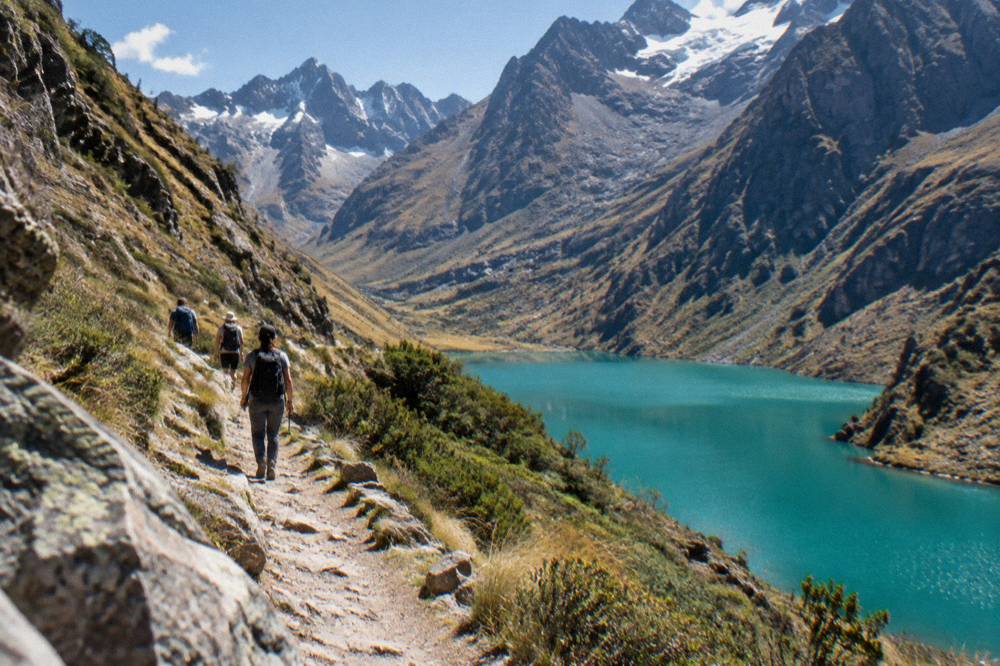
Humantay is the classic first hike: a glacial lake below Salkantay's snowline, reached on a day trip from Cusco with breakfast and lunch commonly included in the roster products. Rainbow Mountain is the highest-profile hike, a community fee of S/ 25 to S/ 30 for foreigners paid in cash at the trailhead, with the Red Valley as an optional extension at about S/ 30 more per one operator guide. Palccoyo is the lower, quieter alternative at a 4,900 m viewpoint with a reported fee of about S/ 20, and the Rainbow Mountain Vs Palccoyo page compares them in full.
The elevation table below shows how each hike relates to the city. Note that the pack gives no sourced trail lengths or walking times for these routes, so none are printed here; the product cards carry each operator's own itinerary.
| Hike | Elevation of the key point | Entry fee reported for foreigners |
|---|---|---|
| Humantay Lake | About 4,200 m | S/ 10 to S/ 20, sources disagree |
| Rainbow Mountain (Vinicunca) | About 5,000 m | S/ 25 to S/ 30, cash |
| Palccoyo | 4,900 m viewpoint | About S/ 20 |
| Waqrapukara | No official ticket; community contribution S/ 10 to S/ 20 | Varies |
| Cusco (Plaza de Armas) for comparison | 3,335 m | Not applicable |
The Humantay product below is the roster's most-reviewed lake option, and the card shows the standard full-day trip with meals.
How Does Altitude Change The Way You Plan A Cusco Adventure?
The CDC Yellow Book names Cusco, at approximately 3,350 m, as a high-altitude destination and advises against ascending from low altitude to a sleeping altitude of 2,750 m or more in a single day; once above 3,000 m it advises moving sleeping altitude up by no more than 500 m per night, with an extra night for every 1,000 m gained. The CDC also notes that travellers to Cusco can descend to lower elevations to sleep for one or two nights before beginning their ascent.
That last sentence is the one most guides skip. Flying into Cusco and immediately hiking to Humantay at about 4,200 m is a rapid ascent by the CDC's own definition, and the Yellow Book states that in rapid-ascent situations where staged acclimatisation is not feasible, rates of altitude illness approach 50 percent, so a low threshold for chemoprophylaxis is advised. Acetazolamide is a prescription decision to make with a doctor, not something to buy at a market stall.
The practical sequence the CDC wording supports: spend the first days in and around Cusco on lower-effort activities, the free things to do in Cusco and the city's museums and markets, before booking the 4,200 m and 5,000 m hikes. The paragliding flight, which launches from valley ground below the city, is not a hiking load on the lungs in the same way, though the outing still involves travel at altitude. The CDC also advises avoiding alcohol for the first 48 hours at high altitude.
Nobody publishes a day count for acclimatisation, and the CDC gives none; what it gives is the ascent arithmetic above. The full reasoning, including the medication question, sits on the Cusco Altitude page.
| CDC Yellow Book rule | The wording, in brief |
|---|---|
| Sleeping altitude ceiling | Avoid going from low altitude to 2,750 m or more in a single day |
| Climb rate above 3,000 m | No more than 500 m of sleeping altitude per night, extra night per 1,000 m gained |
| Cusco specifically | Travellers can descend to lower elevations to sleep for 1-2 nights, then begin ascent |
| Alcohol | Avoid for the first 48 hours at high altitude |
| Medication | Consider acetazolamide if abrupt ascent is unavoidable; prescription decision with a doctor |
When Is The Best Season For Adventure Activities In Cusco?
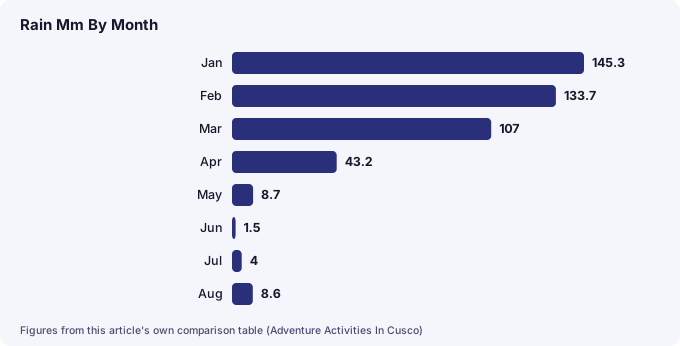
The dry stretch from roughly May to September is the best window for almost every adventure around Cusco: the WMO/SENAMHI "Cuzco" station's historical normal shows May to August bringing just 22.8 mm of rain combined, 3.2 percent of the annual 707.8 mm, while December to March carries 71.9 percent. June to August is winter: dry, clear days with cold nights and frost in June and July.
The inversion trips up visitors from the northern hemisphere every year. June to August is not summer in Cusco; it is winter, with mean minimums of 0.3 C in June and 0.1 C in July at the WMO station, yet mean daily maximums that stay between 18.8 and 20.9 C all year mean the days themselves are mild. A Rainbow Mountain dawn start in July is a freezing one; the same afternoon can feel warm in the sun. The full index of guides sits on Things To Do In Cusco Peru.
The monthly picture from the station record, a historical normal supplied by SENAMHI to the World Weather Information Service:
| Month | Mean max C | Mean min C | Rain mm |
|---|---|---|---|
| Jan | 18.9 | 6.6 | 145.3 |
| Feb | 18.8 | 6.5 | 133.7 |
| Mar | 19.1 | 6.2 | 107.0 |
| Apr | 19.7 | 4.9 | 43.2 |
| May | 19.8 | 2.5 | 8.7 |
| Jun | 19.5 | 0.3 | 1.5 |
| Jul | 19.1 | 0.1 | 4.0 |
| Aug | 19.8 | 1.6 | 8.6 |
| Sep | 19.8 | 3.9 | 21.8 |
| Oct | 20.9 | 5.5 | 39.4 |
| Nov | 20.7 | 6.1 | 71.9 |
| Dec | 19.4 | 6.4 | 122.7 |
What the table means for each activity, in plain terms. Paragliding needs stable air, so the dry months give the most flyable days. The high hikes are possible year-round but the wet season makes the Rainbow Mountain trail muddy and the views less reliable. Rafting depends on river levels, which the wet season raises. The Inca Trail closes every February regardless of weather, and permits are sold only through licensed agencies. Month-by-month detail is on the Cusco Weather By Month and Best Time To Visit Cusco pages.
What Do River And Riding Adventures Around Cusco Involve?
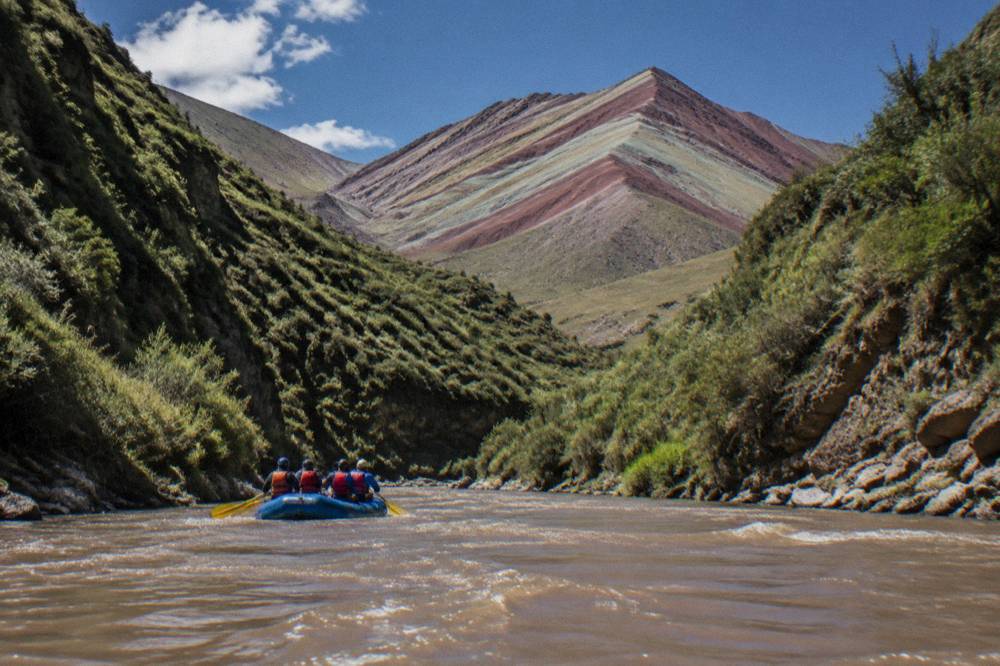
The river and riding options are rafting plus zip lining on the Urubamba River as a combined day, horseback riding from Cusco to the Temple of the Moon and Chacan Mountain, and quad biking on valley tracks between Moray and the Maras salt mines. Each is a guided product booked through an operator's listing, with the Urubamba combo described as a way to add adrenaline to time in Cusco.
The Urubamba combo pairs white-water sections with a canopy zip line in one outing, and the roster listing describes it as exploring Peru's natural landscapes from a different angle. The horseback product rides out from the city to Inca-era sites including the Temple of the Moon, a break from city streets that the listing frames as time in the outdoors. The quad bike tour runs to Moray and the Maras salt mines on ATVs, a half-day adventure that pairs naturally with the valley's archaeological stops.
The rafting card below shows the river product with its verified listing data.
The horseback option is the quieter of the three, and its card carries the listing's own details.
The quad bike tour is the most mechanical of the three, and the card shows the current listing.
The Maras and Moray legs of the quad tour touch two sites with their own ground costs: the salt mines charge a reported S/ 15 to S/ 20, and Moray is covered by the Boleto Turistico's Circuit III, the S/ 70 partial ticket whose terms are explained on the Boleto Turistico page. The road between the two was resurfaced in late 2025 with a new asphalt link handed over in December, per one Peruvian news report.
Which Multi-Day Treks From Cusco End At Machu Picchu?
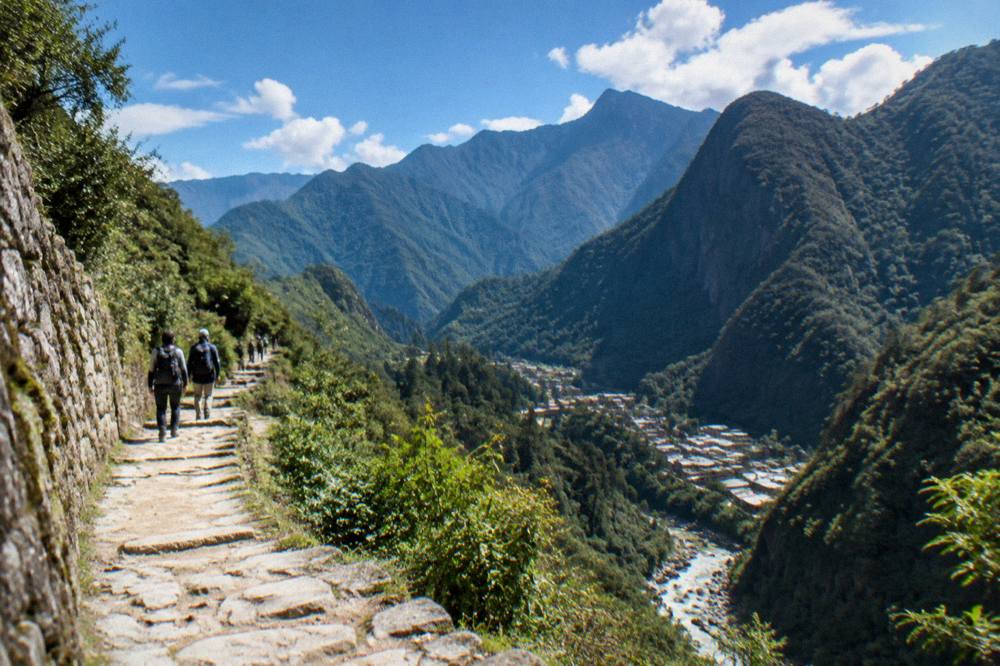
The multi-day trek routes from Cusco are the classic 4-day Inca Trail, the 4-day and 5-day Salkantay treks, the 4-day Lares Valley trek with hot springs, and the 4-day Inca Jungle Trail that mixes biking and hiking. The Inca Trail is permit-controlled at 500 people per day including porters and guides, sold only through licensed agencies, and closed every February; the permit includes Machu Picchu entry.
Machu Picchu has exactly one page on this site, the Machu Picchu day trip guide, so this section stays on the trek question. The Inca Trail's quota is the hard fact that shapes every plan: 500 people a day including all support staff, permits only through licensed agencies, and February closed outright for maintenance. One operator guide reports that permits sell out months ahead for the June to October stretch, though no official lead time exists. The government portion of the permit is reported at about S/ 292 (about US$77 to 85).
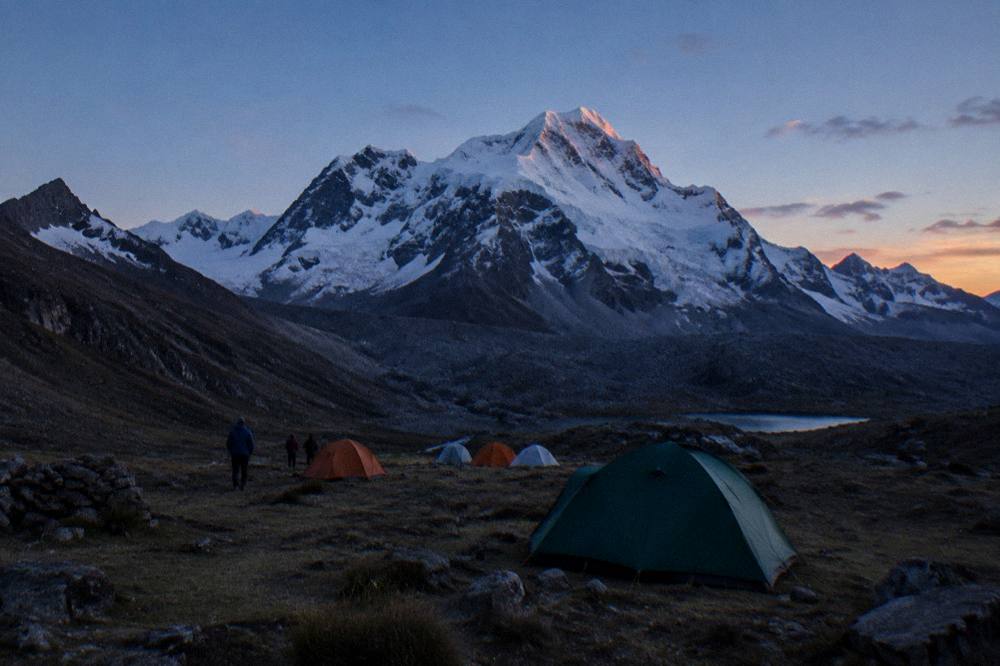
The Salkantay treks in the roster run as a 4-day route with a sky camp stay and the classic 5-day small-group version, both finishing at Machu Picchu, which UNESCO inscribed as a World Heritage Site on 9 December 1983. The Lares trek trades the crowds for hot springs and village routes. The Inca Jungle Trail is the adventure-family option, described on its listing as a 4-day tour of the Inca route from Cusco. The Short Inca Trail in the card below is the two-day version for walkers who cannot commit four days.
A note on the trails' difficulty: the pack holds no sourced figures for trek distances, daily elevation gains or difficulty grades, so none appear here. The booking cards carry each operator's own itinerary, and the Inca Trail, Salkantay, Lares and Choquequirao pages on this site describe the routes in general terms.
How Much Do Adventure Days Around Cusco Cost On The Ground?
The on-the-ground costs the verified facts support are entry and community fees rather than product prices: Rainbow Mountain charges foreigners S/ 25 to S/ 30 in cash, Palccoyo about S/ 20, Humantay Lake S/ 10 to S/ 20 with sources disagreeing, the Maras salt mines S/ 15 to S/ 20, and Q'eswachaka about S/ 20.
Tour prices render from the booking cards, never from typed figures, and everyday costs run about S/ 8 to 15 for a menu del dia and S/ 2 to 5 for a coca tea.
The distinction matters because two different money systems run in parallel here. Community and site fees are paid in soles, in cash, at trailheads and gates, and they are not part of any tour price. Tour prices are set by operators and shown on their live listings. Blending the two into one "total cost" would be inventing a figure, so the table below keeps them separate.
| Ground cost | Reported figure | Notes |
|---|---|---|
| Rainbow Mountain community fee | S/ 25 to S/ 30 | Cash, foreigners; route-dependent |
| Palccoyo fee | About S/ 20 | Operator-reported 2026 |
| Humantay Lake | S/ 10 to S/ 20 | Sources disagree, no single number |
| Maras salt mines | S/ 15 to S/ 20 | 2026 operators |
| Q'eswachaka bridge | About S/ 20 | Operator-reported |
| Menu del dia in Cusco | About S/ 8 to 15 | Everyday range |
| Coca tea | About S/ 2 to 5 | Everyday range |
Sol prices convert at about S/ 3.4 to the US dollar, so S/ 30 is roughly US$9 and S/ 20 roughly US$6. Wider budget planning, including how the Boleto Turistico's S/ 130 integral ticket fits a multi-day adventure itinerary, is covered in the site's costs pages, and the exchange rate itself is quoted by Peru's central bank, the BCRP.
What Should You Pack For Adventure Activities Around Cusco?
Packing for Cusco adventures is governed by two verified facts: the dry-season nights are cold, with mean minimums of 0.3 C in June and 0.1 C in July, and the days stay mild, with mean maximums between 18.8 and 20.9 C all year, so layers matter more than a single heavy jacket, and wet-season months from roughly November to March call for rain gear on any hike.
The daily swing is the packing story. In July the WMO station's historical normal shows a spread of about 19 C between the mean minimum and the mean maximum, which in practice means a freezing dawn start at the Rainbow Mountain trailhead and a warm afternoon in the same day. In January the swing is smaller, 12.3 C, but the rain is heavy, 145.3 mm across the month, so waterproofs replace the deep-warm layers.
For the flights and river days the same logic applies with a twist: valley ground sits below Cusco, so temperatures there run warmer than the city, and river outings end wet. Sun protection belongs in every kit regardless of season, because high-altitude UV is a constant of the Andes, and the CDC's altitude advice, avoiding alcohol in the first 48 hours, is worth pairing with hydration on every hike day. The site's What To Buy In Cusco page covers the alpaca layers and market buys that fill the gaps.
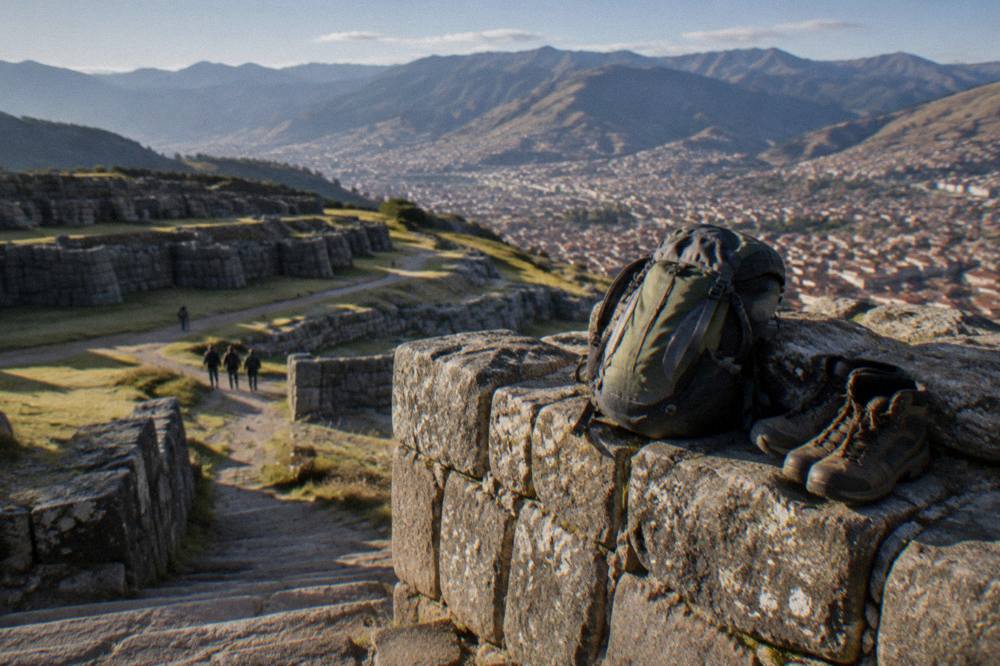
How Do You Fit Adventures Into A Cusco Itinerary?
The sequence that the altitude rules and the season both support is: arrive and spend the first day or two on city and valley-floor activities, including the paragliding flight, then move to the mid-altitude days such as Humantay, and save the highest hikes, Rainbow Mountain and Palccoyo, for the back half of the trip. Multi-day treks belong at the end of a stay, when acclimatisation is done and the trail can be left without losing city days.
The logic comes straight from the CDC arithmetic: the city at 3,335 m is itself above the 3,000 m threshold where the 500 m per night rule applies, so the first nights are already an ascent. Adding a 5,000 m hike on day one is the rapid-ascent scenario the Yellow Book warns about. The Sacred Valley's lower towns, Urubamba at 2,870 m and Ollantaytambo at 2,792 m, even give the descending-to-sleep option the CDC names for Cusco travellers, which is why some itineraries sleep a night or two in the valley before the big hikes.
A week built this way: day one in the city, day two the paragliding or horseback outing, day three Humantay, day four a rest or market day, day five Rainbow Mountain or Palccoyo, then the multi-day trek. The site's itinerary pages, from one day to seven, lay out the full sequences, and the Getting Around Cusco page covers the transport between them.
Common Questions About Adventure Activities In Cusco
Is paragliding in Cusco actually over the city?
No. The roster's tandem paragliding product is flown in the Sacred Valley of the Incas, with specialised instructors, launched from valley ground rather than the hills above Cusco. The valley's warmer, more stable air and its broad floor are what make the flights workable.
Can you hike Rainbow Mountain without a tour?
Yes, and the Rainbow Mountain Vs Palccoyo page covers the comparison. The verified ground cost either way is the community fee, S/ 25 to S/ 30 for foreigners in cash. A guided tour adds transport from Cusco, which is a long way on a pre-dawn start, and the product cards show what each operator includes.
Which is higher, Humantay Lake or Rainbow Mountain?
Rainbow Mountain, Vinicunca, at about 5,000 m is the higher of the two. Humantay Lake sits at about 4,200 m, and the Palccoyo viewpoint at 4,900 m sits between them. All three sit above Cusco's own 3,335 m, which is why the acclimatisation sequence matters before any of them.
Is the Inca Trail open all year?
No. The Inca Trail closes every February for maintenance. Permits run at 500 people per day including porters and guides, are sold only through licensed agencies, and the permit includes Machu Picchu entry. One operator guide reports permits sell out months ahead for June to October, though no official lead time is published.
Do you need altitude medication for adventure activities in Cusco?
That is a prescription decision to make with a doctor. The CDC Yellow Book advises considering acetazolamide to speed acclimatisation when abrupt ascent is unavoidable, names Cusco at approximately 3,350 m as a high-altitude destination, and prefers graded ascent. The full altitude guidance is on the Cusco Altitude page.
What is the best month for adventure activities around Cusco?
The dry stretch from roughly May to September gives the most flyable paragliding days and the most reliable hiking weather, with May to August bringing just 22.8 mm of rain combined at the WMO/SENAMHI Cuzco station. June and July are the coldest nights, with frost, but the clearest days. October is a shoulder month with 39.4 mm and the year's warmest mean maximum at 20.9 C.
The adventure layer around Cusco is wide enough that no single trip covers it, and the honest way to plan it is to match each activity to the altitude and the season rather than the brochure order. The paragliding flight over the Sacred Valley, the lake hikes above the city and the permit-controlled treks to Machu Picchu each reward a different week of the calendar and a different day of an acclimatisation curve, and the verified numbers on this page are the ones to build that plan on.