Rainbow Mountain Vs Palccoyo
Rainbow Mountain (Vinicunca) and Palccoyo are the two striped-mountain day trips from Cusco, and they suit different travellers. This guide compares their altitudes, fees, hike effort and seasons using verified sources.
Short answer
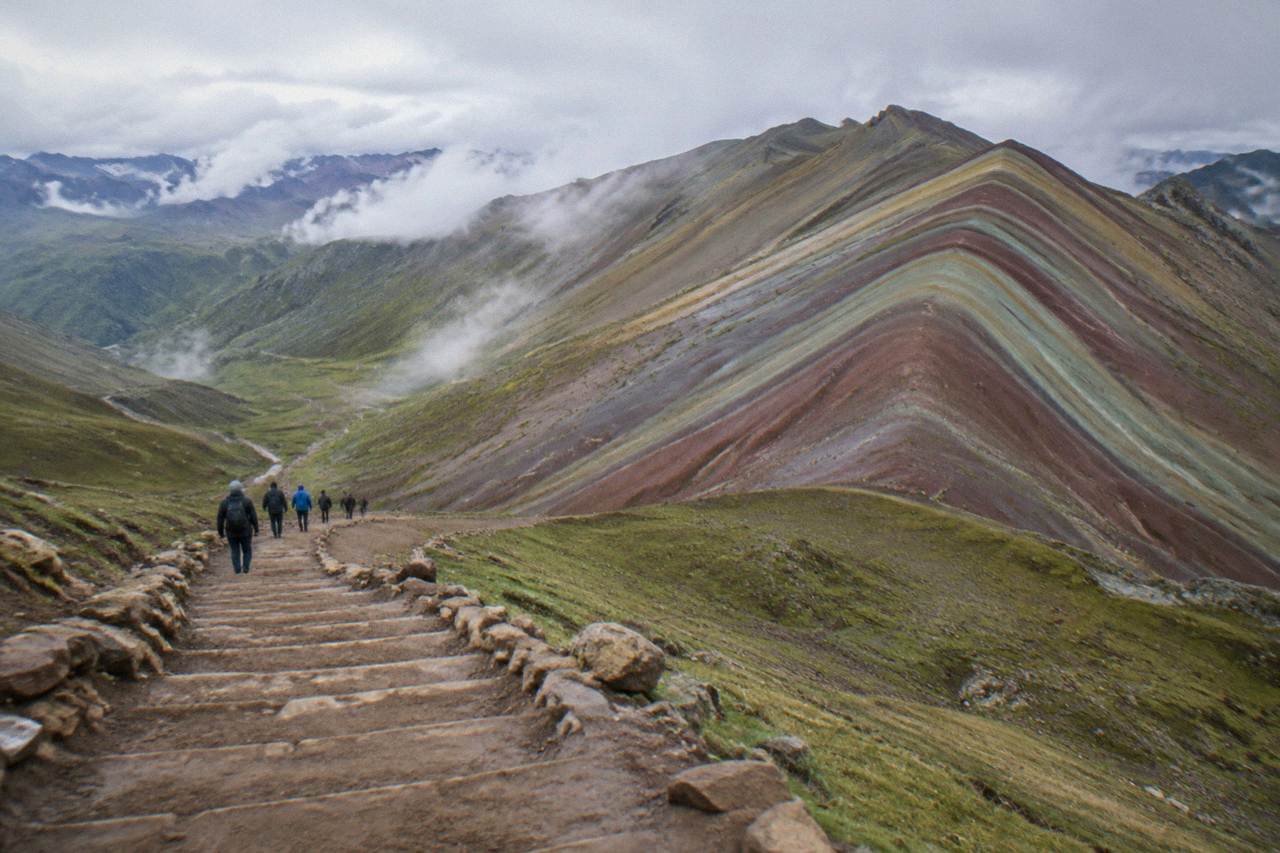
Rainbow Mountain (Vinicunca) sits at about 5,000 m and involves a longer, steeper walk to the main viewpoint; Palccoyo's viewpoint is at 4,900 m with a shorter, gentler trail and far fewer visitors. Rainbow Mountain's community fee is S/ 25 to S/ 30 for foreigners in cash; Palccoyo's is about S/ 20. Both are full-day trips from Cusco and both sit above the city's 3,335 m, so the CDC's graded-ascent advice applies to each.
Rainbow Mountain and Palccoyo are the two striped-mineral mountain day trips that leave Cusco before dawn, and choosing between them is one of the most common planning questions for the Andes of southern Peru. Both sit high above the city: Cusco's Plaza de Armas is at 3,335 m, while Vinicunca, the mountain most guidebooks call Rainbow Mountain, stands at about 5,000 m and the Palccoyo viewpoint reaches 4,900 m. This page compares the two using the community entry fees reported in 2026, the trail profiles, the climate record for the Cusco basin and the altitude guidance the CDC publishes for rapid-ascent destinations such as Cusco.
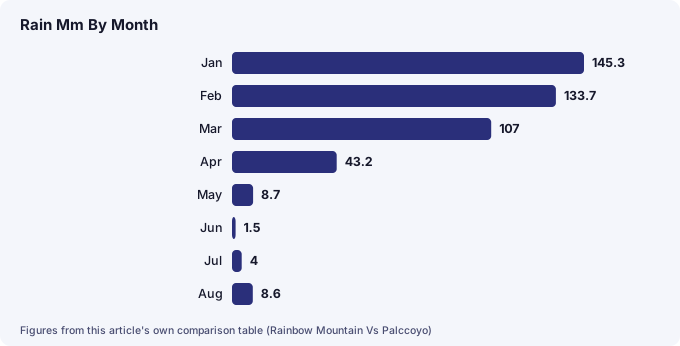
Neither mountain is inside the city, and neither is Machu Picchu, which sits far lower at 2,430 m and has its own page at the Machu Picchu day-trip guide. Both Vinicunca and Palccoyo are natural sites in high Andean country southeast of Cusco, reached by road through Quechua farming communities, and both charge a community fee paid in soles cash at the trailhead. What differs is the shape of the day: how long you walk, how steep the final climb is, how many people share the viewpoint with you, and how the mountain looks when cloud or rain closes in.
What Is The Difference Between Rainbow Mountain And Palccoyo?
Rainbow Mountain (Vinicunca) is the famous one: a single, dramatic striped peak at about 5,000 m, reached by a longer walk with a steep final climb, and it draws the crowds that fame brings. Palccoyo is the quieter alternative at a 4,900 m viewpoint, with a shorter and gentler trail across several striped slopes, a lower community fee and far fewer visitors on the same style of day trip from Cusco.
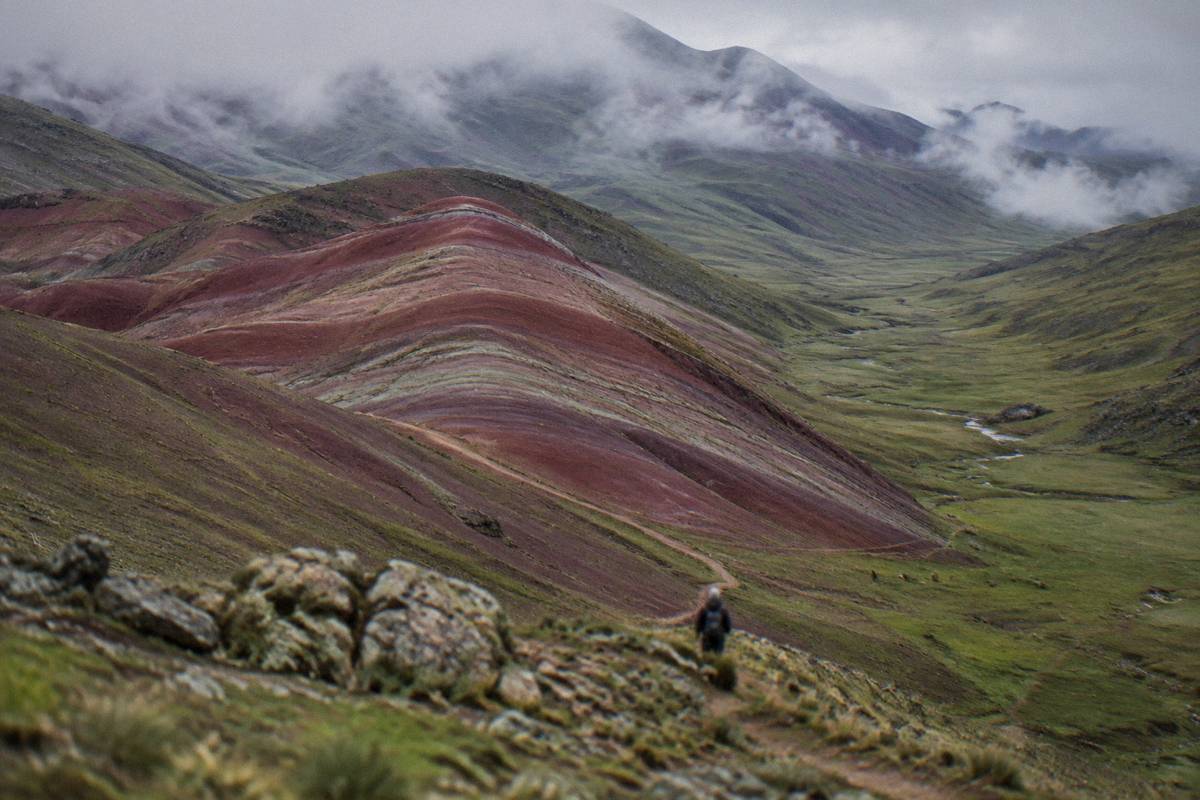
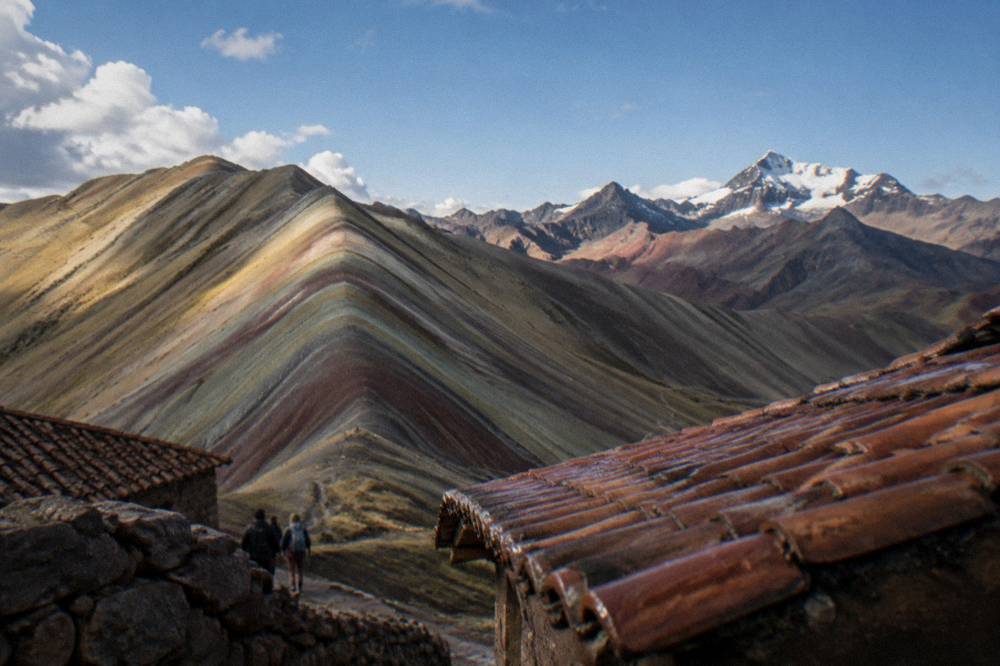
The core distinction is what you are looking at. Vinicunca is one mountain whose entire flank is banded in mineral colour, and the classic photograph is taken from a ridge opposite it after a sustained climb. Palccoyo is a chain of striped hills, several of them coloured at once, and the viewpoint is reached on a much flatter path. Peru's official tourism portal, peru.travel, describes Vinicunca as "the beautiful mountain of seven colors" and gives Palccoyo's viewpoint as 4,900 m, so the two sites are documented side by side in official material rather than one being a copy of the other.
The second distinction is the walk itself. The Vinicunca route involves a longer approach on foot from where transport stops, with a final steep ascent to the main viewpoint; the Palccoyo route is shorter and more level, which matters a great deal at close to 5,000 m, where every metre of climbing costs more breath than it does at Cusco's altitude. Neither route involves technical climbing. Both are walked trails on open high-altitude grassland, and both are sold as guided day trips from Cusco because the trailheads sit beyond the reach of a casual taxi ride.
The third distinction is cost and crowds. The community fee at Vinicunca is reported at S/ 25 to S/ 30 for foreigners depending on the access route (about US$7 to US$9), with peru.travel itself listing S/ 30 for foreign visitors. At Palccoyo, operators reported about S/ 20 for foreigners in 2026, while older official pages gave S/ 10 to S/ 15. No source in the verified pack ranks one mountain as "better"; the choice comes down to fitness, tolerance for crowds and the kind of photograph a traveller wants to bring home.
| Feature | Rainbow Mountain (Vinicunca) | Palccoyo |
|---|---|---|
| Viewpoint altitude | About 5,000 m | 4,900 m (peru.travel) |
| Trail character | Longer walk, steep final climb to the viewpoint | Shorter, gentler trail across several striped slopes |
| Community fee, foreigners | S/ 25 to S/ 30 in cash (about US$7 to US$9) | About S/ 20 reported in 2026 |
| What you see | One famous striped peak from a facing ridge | A chain of several coloured hills |
| Day-trip format from Cusco | Full-day guided tour, pre-dawn departure | Full-day guided tour, pre-dawn departure |
Which Is Easier To Hike, Rainbow Mountain Or Palccoyo?
Palccoyo is the easier walk of the two: its trail is shorter and far less steep, and its viewpoint sits about 100 m lower than Vinicunca's, so the physical effort and the altitude load are both smaller. Rainbow Mountain's route demands a longer approach and a sustained final climb at about 5,000 m, which makes it the harder day even for walkers who handle Cusco's 3,335 m comfortably.
The honest framing is that both days are hard by the standards of a lowland holiday, because both start from a city already above 3,300 m and finish within a few hundred metres of 5,000 m. The CDC's Yellow Book names Cusco, at approximately 3,350 m, as a rapid-ascent destination and advises graded ascent where it is feasible: avoid going from low altitude to a sleeping altitude of 2,750 m or more in a single day, and once above 3,000 m, move sleeping altitude by no more than 500 m per night. A day trip to either mountain does not raise sleeping altitude, but it does take the body to extreme daytime height hours after arriving in Cusco, which is why operators and the Cusco altitude guide both suggest saving these trips for after a few acclimatisation days.
| CDC ascent guidance (Yellow Book) | The rule as published |
|---|---|
| Sleeping altitude | Avoid a single-day rise from low altitude to sleeping at 2,750 m or more |
| Above 3,000 m | Increase sleeping altitude by no more than 500 m per night |
| Catch-up rule | Allow one extra night for every 1,000 m gained |
| Cusco specifically | Named at approximately 3,350 m as a rapid-ascent destination |
| Medication | Acetazolamide is a prescription decision to discuss with a doctor |
| First 48 hours | The CDC advises avoiding alcohol after abrupt ascent |
On the trail, the difference is concrete. The Vinicunca day involves a long walk in from the drop-off point and a final climb that gains real elevation on a slope with no shade; horses are offered along part of the route by local operators, a detail widely reported in tour descriptions. The Palccoyo day keeps the walking short and mostly level, and the viewpoint arrives without the same sustained push. For travellers who want the striped-mountain photograph without the hardest climb, Palccoyo is the logical pick; for those who want the iconic single peak and are confident at altitude, Vinicunca rewards the effort.
Both trips run as guided day tours from Cusco, and the site's featured Palccoyo option handles transport and meals in one booking:
The Salkantay trek appears in that trio because some travellers use a multi-day trek as their mountain experience instead of a day trip, and its own listing carries the price, rating and itinerary. For a straight comparison of the two day options, the Palccoyo day-trip guide and the Rainbow Mountain day-trip guide carry the site-by-site detail.
What Do Rainbow Mountain And Palccoyo Cost?
The community fee at Rainbow Mountain is S/ 25 to S/ 30 for foreigners in soles cash, depending on the access route, and Palccoyo's is about S/ 20, also in cash. Neither fee is covered by the Boleto Turistico, which is a city-and-valley ticket for 16 archaeological and museum sites, and neither mountain is free to enter.
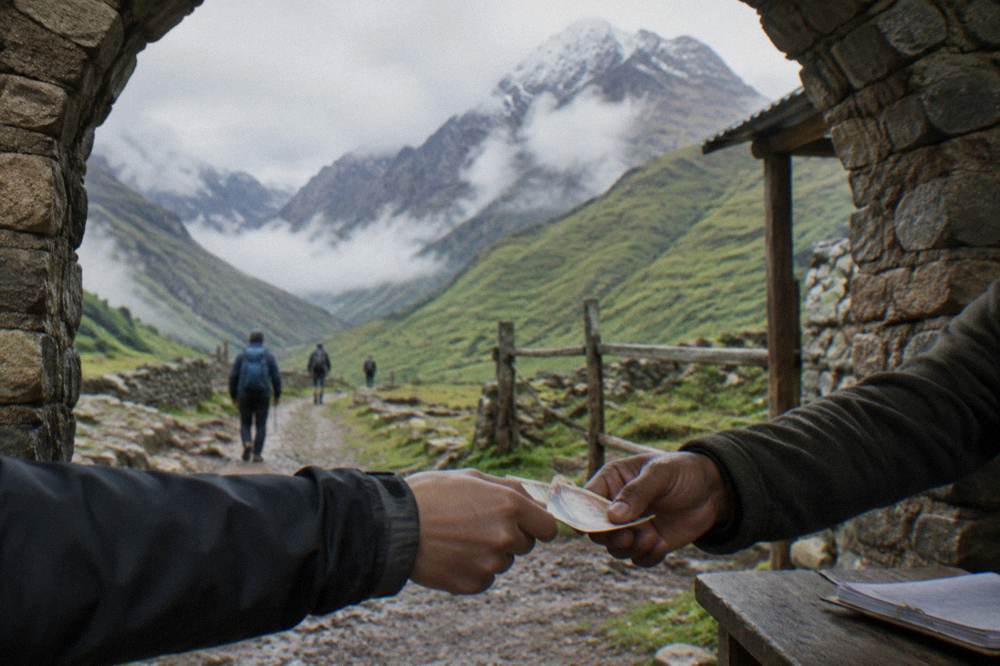
The cash detail matters more than the amounts. Both fees are collected by local communities at or near the trailhead, and the verified reports all describe payment in soles. Peru.travel lists S/ 30 for foreign visitors at Vinicunca and S/ 20 for nationals, while operator guides report S/ 25 via the Cusipata route and S/ 30 via Pitumarca. At Palccoyo, operators reported about S/ 20 for foreigners in 2026, with older official pages showing S/ 10 to S/ 15, so the fee has drifted upward and travellers should carry a little margin.
| Cost item | Rainbow Mountain (Vinicunca) | Palccoyo |
|---|---|---|
| Community fee, foreign adult | S/ 25 to S/ 30 in cash (about US$7 to US$9) | About S/ 20 in cash (about US$6) |
| Fee collector | Local community at the trailhead | Local community at the trailhead |
| Covered by Boleto Turistico? | No | No |
| Payment method | Soles cash | Soles cash |
Beyond the trailhead fee, the real cost is the tour, and tour prices are printed by the product cards on this site rather than typed into prose. The featured Palccoyo all-inclusive trip lists its live price, rating and review count on its own page, as does the Palcoyo scenic-hike tour with Andean lunch. Rainbow Mountain trips follow the same pattern. What the verified pack does say about money generally: the currency is the Peruvian sol, written S/, the exchange rate runs about S/ 3.4 to the US dollar, and card surcharges and mobile-payment acceptance at remote trailheads are not verified, so cash remains the safe assumption.
One caution on bundled pricing: some day tours include the community fee and some collect it separately on the bus. The tour listing states what is included, and that is the document to trust rather than any rounded figure in an article.
Which Has Fewer Crowds, Vinicunca Or Palccoyo?
Palccoyo has fewer visitors: it developed as the quieter alternative to Vinicunca, and its shorter trail and lower profile keep group numbers smaller. Rainbow Mountain is the internationally famous site, so it concentrates the largest share of Cusco's day-trip traffic on one viewpoint ridge, especially in the dry-season peak from June to August.
The verified visitor dataset counts entries at Machu Picchu and the major archaeological sites, not at Vinicunca or Palccoyo, so no sourced headcount exists for either mountain. What is sourced is the seasonal pattern of Andean tourism in the region: Machu Picchu's 2025 monthly figures from the MINCETUR open dataset show October drawing 154,105 visitors against February's 79,806, a factor of 1.93, and that same dry-season concentration applies to every outdoor day trip sold from Cusco, both mountains included. More of these guides are collected on Things To Do In Cusco Peru.
The practical read is that crowd levels are a function of fame and season. Vinicunca appears in most international coverage of Peru, so its ridge fills with tour groups in the dry season; Palccoyo's trail, reached by a different road, spreads its smaller traffic across several coloured hills rather than one pinch point. In the wet season, both quieten considerably, but the trade-off is weather: at these altitudes, rain and cloud can erase the colours entirely, and a summit day in cloud delivers grey rock and nothing else. The is Rainbow Mountain real page covers the geology behind the stripes, and why is Rainbow Mountain closed addresses the closure rumours honestly: no closure has been announced, and access is set by operators and local communities.
For travellers who want the quietest realistic version of either mountain, the levers are the same: go outside the June-to-August peak, accept a wetter month, and start early. Both levers are easier to pull on Palccoyo, where the shorter trail makes a later, less congested start less punishing.
When Is The Best Season For Each Mountain?
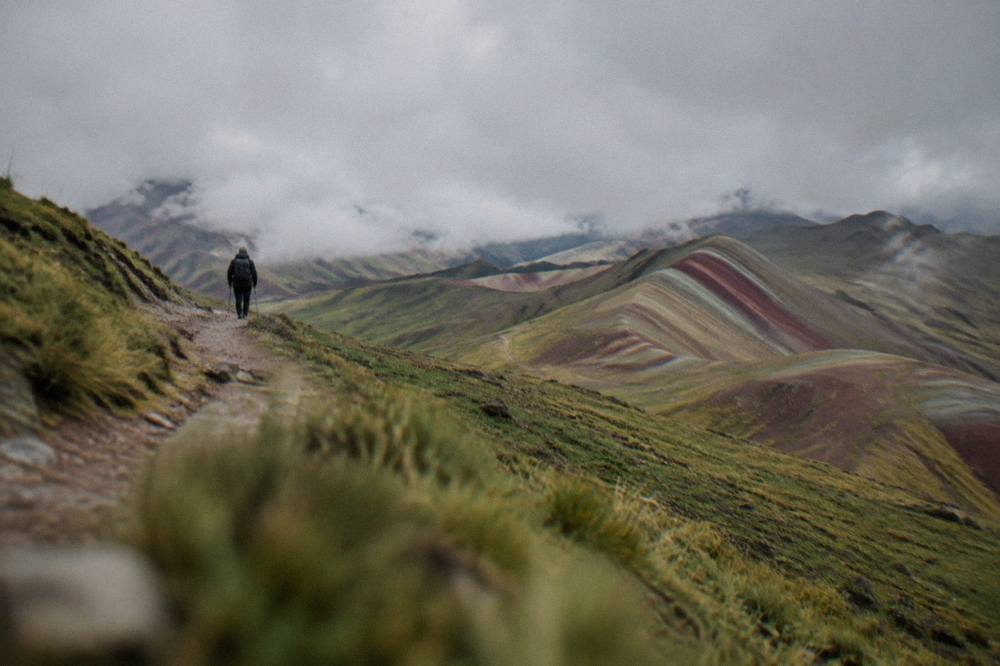
The dry season, roughly May to September, is the safest window for both mountains, because rain and cloud are the single biggest threat to a striped-mountain view; but June to August is also the busiest and coldest window, with frost common at night. December to March delivers 71.9 percent of Cusco's annual 707.8 mm of rain, so a wet-season visit gambles the view against thinner crowds.
The climate record behind this comes from the WMO World Weather Information Service station "Cuzco", supplied by SENAMHI, a historical normal rather than a 1991-2020 table. It shows a Southern Hemisphere high-Andes year: mean daily maximums hold between 18.8 and 20.9 C in every month, while mean minimums plunge to 0.1 C in July and 0.3 C in June, a day-night swing of about 19 C in midwinter. Rain concentrates hard in the wet months: December to March delivers 508.7 mm of the annual 707.8 mm, while May to August together bring just 22.8 mm.
| Month | Mean max C | Mean min C | Rain mm | Verdict for the mountains |
|---|---|---|---|---|
| Jan | 18.9 | 6.6 | 145.3 | Wet; high cloud risk |
| Feb | 18.8 | 6.5 | 133.7 | Wet; high cloud risk |
| Mar | 19.1 | 6.2 | 107.0 | Wet, improving late month |
| Apr | 19.7 | 4.9 | 43.2 | Shoulder; decent odds |
| May | 19.8 | 2.5 | 8.7 | Dry season begins; strong choice |
| Jun | 19.5 | 0.3 | 1.5 | Dry and cold; busiest month |
| Jul | 19.1 | 0.1 | 4.0 | Driest, coldest; frost common |
| Aug | 19.8 | 1.6 | 8.6 | Dry; crowds still high |
| Sep | 19.8 | 3.9 | 21.8 | Dry tail; good balance |
| Oct | 20.9 | 5.5 | 39.4 | Warmest max; rain returning |
| Nov | 20.7 | 6.1 | 71.9 | Wet season building |
| Dec | 19.4 | 6.4 | 122.7 | Wet; high cloud risk |
The months that balance weather against crowds are May and September: dry enough to trust the sky, outside the June-to-August crush, and before the wet season shuts the colour down. The Cusco weather by month and best time to visit Cusco guides carry the full seasonal picture for the whole region.
Between the two mountains, the season argument slightly favours Palccoyo in the shoulder months. Its shorter trail means less exposure time if weather turns, and its several coloured hills give a partly cloud-affected day more to work with than a single viewpoint does. Vinicunca in cloud is a long walk to a grey wall; that risk is the same in any month, but it costs more in effort.
Can You Visit Rainbow Mountain Or Palccoyo Without A Tour?
Independent travel to either mountain is possible in principle, because the trailheads are reached by public road through Cusipata or Pitumarca for Vinicunca and via the Palccoyo road for Palccoyo, but the verified pack holds no colectivo fares or timetables for these specific routes, so the practical, well-documented way to reach either is a guided day tour from Cusco.
What the pack does verify is the fee structure waiting at the far end (S/ 25 to S/ 30 at Vinicunca, about S/ 20 at Palccoyo, cash) and the altitude mathematics that make a pre-dawn start valuable: both viewpoints sit well above 4,900 m, and tour transport compresses the driving hours into darkness so the walking happens in daylight.
The Rainbow Mountain without a tour answer page carries the fuller independent-travel discussion, including the community-fee reality that "free" is the wrong word for either site. For Palccoyo, the same logic applies with one addition: the road is longer and the transport thinner, which is why even independent-minded travellers mostly book the guided day. The site's featured options are below:
For travellers weighing the whole week rather than one day, the instead of Rainbow Mountain page lists alternatives, and Rainbow Mountain or Machu Picchu first addresses sequencing, since many itineraries pair a mountain day with the citadel. The general rule from altitude medicine, rest low and climb high, argues for keeping the 5,000 m day late in a Cusco stay, after the citadel and the Sacred Valley rather than before them.
Which One Should You Actually Choose?
Choose Rainbow Mountain (Vinicunca) if the single iconic photograph is the goal and the steep climb at about 5,000 m is acceptable; choose Palccoyo if the priority is an easier walk, a lower fee, fewer people and a chain of coloured hills instead of one peak. There is no sourced ranking between them, so the decision is about fitness, crowds and season, not about one being objectively better.
If the iconic striped peak is the one you want, book a Rainbow Mountain day trip here.
That last clause is deliberate. No survey, ranking or head-to-head verdict exists in the verified sources; what exists is a set of measurable differences, and they point different travellers in different directions. A confident high-altitude hiker in August who wants the famous shot takes Vinicunca and accepts the ridge traffic. A family, a shorter-stay visitor or someone who felt Cusco's 3,335 m hard takes Palccoyo and gets the same mineral geology with a fraction of the effort. The Humantay harder than Rainbow Mountain comparison follows the same logic for a third mountain option.
| If this describes you | The better pick | Why |
|---|---|---|
| Want the famous single-peak photograph | Rainbow Mountain (Vinicunca) | One dramatic striped flank, the classic image |
| Prefer a short, level walk | Palccoyo | Gentler trail, viewpoint at 4,900 m |
| Sensitive to altitude after arriving in Cusco | Palccoyo | Less climbing at extreme height |
| Travelling in the June-to-August peak and dislike crowds | Palccoyo | Smaller traffic on a wider site |
| Confident hiker, dry season, want the full experience | Rainbow Mountain (Vinicunca) | The steep climb is the price of the icon |
| Tight budget on trailhead fees | Palccoyo | About S/ 20 versus S/ 25 to S/ 30 |
Two practical footnotes close the comparison. First, the oxygen question: no sourced figure exists for oxygen saturation at either mountain, so the Rainbow Mountain oxygen level page stays honest about that gap, and this one does too. Second, both days end back in Cusco by evening, which makes either a natural pairing with the city's food scene covered in what to eat in Cusco; a hot meal and an early night are what the altitude literature and every operator both recommend after a 5,000 m day.
Common Questions About Rainbow Mountain Vs Palccoyo
Is Palccoyo the same mountain as Rainbow Mountain?
No. Palccoyo is a separate site with its own striped hills and its own trailhead, reached by a different road from Cusco. Vinicunca is the famous single peak most guidebooks call Rainbow Mountain, at about 5,000 m; the Palccoyo viewpoint is 4,900 m per peru.travel. The two are alternatives, not two names for one place.
Which is cheaper, Rainbow Mountain or Palccoyo?
The trailhead fee is lower at Palccoyo: about S/ 20 for foreigners reported by operators in 2026, versus S/ 25 to S/ 30 at Vinicunca depending on the access route. Tour prices are printed on each product's live listing, and this site does not type them into prose. Both fees are paid in soles cash at the trailhead.
Is Palccoyo easier than Rainbow Mountain?
Yes, on the documented facts: the Palccoyo trail is shorter and gentler, and its viewpoint sits about 100 m lower than Vinicunca's. Both are extreme-altitude days from a city at 3,335 m, so neither is trivial, and the CDC's guidance on rapid ascent to high altitude applies to both.
Can you see Machu Picchu from either mountain?
No. Both Vinicunca and Palccoyo lie in high Andean country southeast of Cusco, far from Machu Picchu, which sits at 2,430 m on the far side of the region. They are separate day trips, and many itineraries do one mountain day plus a separate Machu Picchu day.
Is Rainbow Mountain ever closed?
No closure is recorded in the verified sources, and access is set by operators and local communities; weather closes individual days, not the site. Rumours of permanent closure circulate online, but the pack behind this page found no official closure and no current access restriction for either mountain.
Do you need a guide for Rainbow Mountain or Palccoyo?
Neither site carries a mandatory-guide rule in the verified sources, unlike some Peruvian archaeological sites with official ticketing. Independent travel is possible in principle, but no verified colectivo fare or timetable exists for either trailhead route, which is why the guided day tour from Cusco is the practical, documented way to reach both.
The comparison, in one sentence: Vinicunca is the harder, higher, more famous day with the bigger crowds and fee, Palccoyo is the shorter, cheaper, quieter one with several coloured hills instead of a single icon, and the season, a traveller's legs and their tolerance for sharing a ridge do the rest. Whichever way the decision goes, the CDC's graded-ascent advice, the cash trailhead fees and the dry-season window are the three facts worth carrying up the mountain.