What To Avoid In Cusco?
The mistakes worth avoiding in Cusco, from night walking and untreated water to online Boleto Turistico sellers and wet-season trail plans, each traced to the UK FCDO, the CDC, COSITUC and the WMO weather record.
Cusco, the historic city in the Andes of southern Peru, holds its Plaza de Armas at 3,335 m, and the mistakes visitors make here repeat with remarkable consistency: climbing too fast from sea level, walking home alone late at night, drinking untreated water, and shopping for tickets through channels the official system does not use. Every one of those errors has a named official source behind the correction. The UK FCDO writes the night-walking rule in plain words, the CDC writes the water and altitude rules, COSITUC writes the ticket rules, and the WMO station record writes the seasonal ones. This page puts them together in the order a trip actually unfolds, and every number below traces to a verified dataset rather than to anecdote.
What To Avoid In Cusco?
The main things to avoid in Cusco are walking alone in quiet areas or at night, drinking untreated water, treating the Boleto Turistico as an online purchase, ignoring the 3,335 m altitude on day one, and expecting dry trails in the wet months of December to March, when 71.9 percent of the year's rain falls. Each of these rules has a named official source behind it, from the UK FCDO to COSITUC and the WMO station record.
Altitude comes first because it is the one mistake that is locked in before arrival. The CDC Yellow Book lists Cusco as a high-altitude destination at approximately 3,350 m and names it as a place travellers typically reach by rapid ascent, where staged acclimatisation is not feasible. In exactly those abrupt-ascent situations the CDC writes that rates of altitude illness approach 50 percent, which is a statement about the situation, not a prediction about any individual traveller. The same chapter prefers graded ascent, advises avoiding alcohol for the first 48 hours at high altitude, and treats acetazolamide as a prescription decision to make with a doctor, never a self-prescription.
There is a lesser-known CDC line that fits Cusco specifically: in some rapid-ascent cities, travellers can descend to elevations lower than the airport to sleep for one or two nights and then begin the ascent, which the Yellow Book says can remove the need for medication. The Sacred Valley sits lower than the city, Ollantaytambo at 2,792 m and Urubamba at 2,870 m against the Plaza de Armas at 3,335 m, which is why the sleep-low-first approach has a real geography behind it. Two companion pages on this site go deeper: how likely altitude sickness is in Cusco and how long acclimatisation takes.
The Things To Do In Cusco Peru home page carries a monthly visitor block drawn from MINCETUR's open dataset, and it is worth checking before any crowd-sensitive plan: Machu Picchu recorded 1,479,506 visitors in 2025, and the monthly spread within that total is wide enough to change what a day on site feels like. The rest of this page works through the other avoidable errors in order: places and hours, purchases, food and drink, timing, and clothing.
Which Parts Of Cusco Should You Avoid, And When?
The UK FCDO names Cusco among Peru's cities where street crime, including muggings and thefts, is a significant problem, and advises not walking on your own in quiet areas or at night. The VRAEM zone, including Pichari, Quimbiri and Vilcabamba in the Cusco region, is the one area foreign governments tell travellers to avoid outright. The tourist police run a 24-hour line on 980 122 335.
The FCDO wording deserves quoting directly because it is more specific than most safety advice: street crime, including muggings and thefts, is a significant problem in Lima, Cusco, Arequipa and other major cities, and the advice is do not walk on your own in quiet areas or at night. The same page warns about express kidnapping by fake taxi drivers, usually at night, which is the sourced reason the night rule covers taxis too and not only dark side streets. None of this describes Cusco as dangerous in general; it describes hours and habits, which is exactly what a visitor can control.
The US State Department advisory for Peru stands at Level 2, Exercise Increased Caution, reissued on 8 September 2026, and its geography matters: Cusco city, the Sacred Valley, the Inca Trail and Machu Picchu all sit outside the advisory's Do Not Travel areas. The areas foreign governments do tell travellers to avoid are in the VRAEM, and the UK, Canadian and Australian advisories all name parts of the Cusco region within it: Pichari, Quimbiri and Vilcabamba. None of those places is on any standard tourist route from the city. Australia's advisory adds one practical note, that strikes can occasionally disrupt transport to Machu Picchu, which is a reason to keep an eye on operator notices rather than a reason to expect a disruption.
| Source | Current standing | What it means for Cusco |
|---|---|---|
| US State Department | Level 2, Exercise Increased Caution, reissued 8 September 2026 | Cusco city, the Sacred Valley, the Inca Trail and Machu Picchu sit outside the Do Not Travel areas |
| UK FCDO | Street crime, including muggings and thefts, is a significant problem in major cities including Cusco | Do not walk on your own in quiet areas or at night |
| CDC Peru notice | Level 1, Practice Usual Precautions | Machu Picchu is at high altitude; talk to a doctor before travel |
| Canada and Australia | Exercise a high degree of caution | Avoid the VRAEM, including Pichari, Quimbiri and Vilcabamba in the Cusco region |
Two contacts are worth saving before arrival. The Policia de Turismo runs a 24-hour phone and WhatsApp line on 980 122 335, and iPeru, the tourist information service, answers on WhatsApp at +51 944 492 314 and on phone (01) 574 8000 around the clock. A fuller neighbourhood-by-neighbourhood treatment, including the areas where the standard advice tightens, sits on the companion page which parts of Cusco to avoid.
What Should You Avoid Buying In Cusco?
Avoid buying a Boleto Turistico online or from anyone other than a COSITUC counter: the official FAQ states it is sold in person only, at Av. El Sol 103 and at most included sites, never online. Also avoid paying any community site fee to someone with no ticket operation: Rainbow Mountain's fee runs S/ 25 to S/ 30 in cash, Palccoyo about S/ 20, and the Maras salt mines S/ 15 to S/ 20.
The Boleto Turistico rule is the clearest ticket trap in the city because the official position is unambiguous. COSITUC's FAQ states the pass is not sold online at all; the counter at Av. El Sol 103, open daily 07:30 to 18:00, and most of the 16 included sites are the only official sales points. Any website offering to sell the pass is by definition outside the official system. The integral ticket for a foreign adult is S/ 130, about US$38, valid 10 days from the day of purchase, and the three partial circuits cost S/ 70 each, about US$20, with Circuit I valid one day and Circuits II and III valid two days. Children are free to age 9, and the only discount COSITUC lists is the student rate.
The second ticket trap is assuming the boleto covers Machu Picchu. It does not, and never has within the current system: Machu Picchu entry sells on the Ministry of Culture's ticket platform or in person at the Machu Picchu Pueblo office, which the official page caps at 1,000 tickets per day, valid for entry the following day. Foreign adult entry runs from about S/ 163 on standard routes and S/ 211 on mountain routes, both including the S/ 11 SERNANP fee that has applied since 1 May 2026, and the platform shows the live price. Since 22 September 2026 the platform has also been running a trial that removed the prior reservation hold and gives buyers 15 minutes to complete payment before the slot is released, so check how it stands when booking. Tickets are nominal: valid only for the stated date, hour, circuit and holder, with a single passport-number typo as the only correction allowed.
| Ticket or fee | What sources report | Notes |
|---|---|---|
| Boleto Turistico integral, foreign adult | S/ 130, 10 days, 16 sites | In person only, Av. El Sol 103 counter, daily 07:30 to 18:00 |
| Boleto partial circuits I, II, III | S/ 70 each | Circuit I valid 1 day, Circuits II and III valid 2 days |
| Rainbow Mountain community fee | S/ 25 to S/ 30, cash | Cusipata route S/ 25, Pitumarca route S/ 30 |
| Palccoyo community fee | about S/ 20 | Operator-reported for 2026 |
| Maras salt mines | S/ 15 to S/ 20 | 2026 operator figures |
| Humantay Lake | S/ 10 to S/ 20 | Sources disagree; no single verified figure |
| Q'eswachaka | about S/ 20 | Operator-reported |
The community fees in that table are the third trap, in the opposite direction: they are real, they are collected at the site, and they are paid in soles cash. Rainbow Mountain is not free, and neither is Palccoyo. Budget the cash rather than assuming a tour price has absorbed everything.
One purchase in Cusco is hard to fake, and it makes a useful contrast with the stall souvenirs: a bean-to-bar chocolate workshop, where the cacao goes from raw material to a finished bar in the visitor's own hands. The ChocoMuseo chocolate workshop runs in the city centre, and it is the kind of product where what you take home is something you made rather than something you haggled over.
For travellers weighing a guided purchase against an independent one, the same logic applies to activities as to tickets: the official channel is the one that states its own terms. A workshop states its ingredients, a paragliding operator states its instructors, and a licensed guide states the route. What to avoid is the unnamed reseller, the price with no operator behind it, and the ticket that cannot be checked against an official platform.
What Should You Avoid Eating And Drinking In Cusco?
The CDC advises avoiding contaminated water in Peru and drinking bottled, boiled or treated water, so untreated tap water is the single thing to avoid drinking in Cusco. The same official pages put yellow fever vaccination out of scope for the highland tourist circuit: the vaccine is not required for entry, and the CDC does not recommend it for travel limited to Cusco city, the Inca Trail or Machu Picchu.
The water line is deliberately narrow because the official line is narrow. The CDC Peru page advises avoiding contaminated water and drinking bottled, boiled or treated water, and that is as far as any sourced guidance on this page goes; no stronger tap-water verdict belongs here. Food safety follows the same pattern, and the companion page on avoiding food poisoning in Cusco covers the practical ground in detail, from market stalls to restaurant choices.
Two dining expectations are worth correcting before they cost money. The first is the assumption of Michelin-starred dining in Cusco: the Michelin Guide lists no restaurants in Peru at all, its Peruvian-cuisine selection sits entirely abroad, so no Cusco restaurant carries a Michelin star. Recognition does exist, in a different system: Mil, in the Sacred Valley at Moray, placed at No. 49 in Latin America's 50 Best Restaurants list for 2025, the strongest sourced dining credential in the Cusco area. The second expectation is tipping: How to Peru's guidance, an editorial source worth attributing, suggests leaving up to 10 percent in restaurants only when no servicio charge is already on the bill, and tipping free-walking-tour guides S/ 20 to S/ 40 per person, day-tour guides S/ 10 to S/ 20, and drivers S/ 5 to S/ 10.
Cash handling has its own avoid-list. How to Peru reports that per-transaction ATM caps typically run 400 to 700 soles, that foreign-card surcharges are typically quoted at S/ 18 to S/ 36, and that airport and hotel machines are usually the most expensive, so the pattern to avoid is the first machine in the arrivals hall. The same source advises declining the machine's offer to convert the withdrawal to a home currency. An airport taxi to the centre is reported at about S/ 15 to 25, a range rather than a tariff, agreed before the ride.
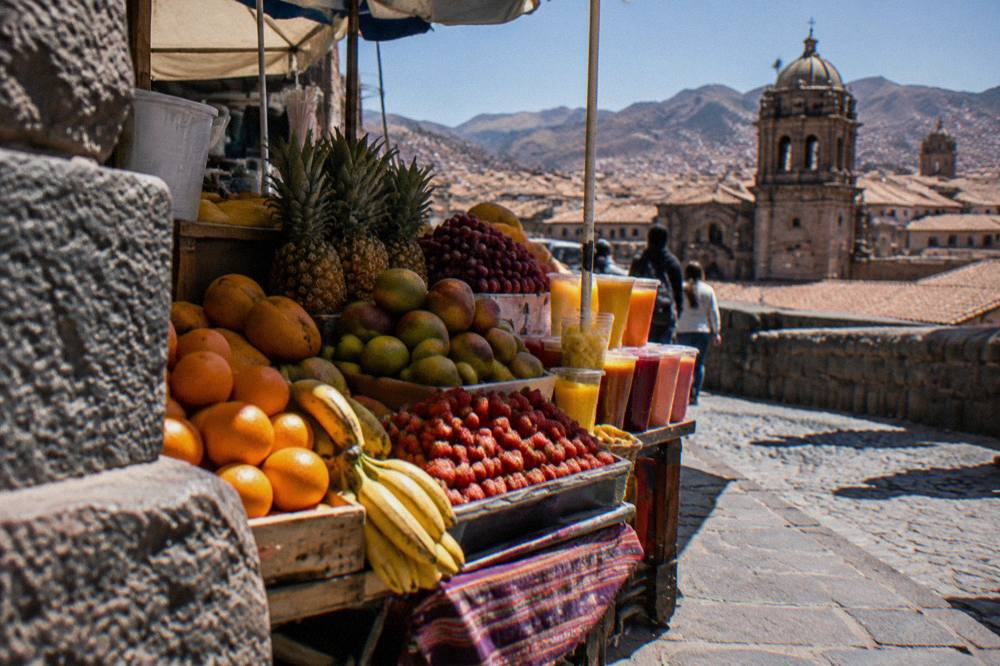
On the eating side of the ledger, the positive counterpart to the avoid-list is the city's food culture itself, from the San Pedro Market stalls to its cooking classes. The bean-to-bar chocolate workshop fits here as much as in the shopping section: cacao is food history as much as souvenir, and a workshop session covers the whole chain from the tree to the moulded bar.
When Should You Avoid Visiting Cusco?
Avoid the deepest wet-season months if clear trails matter: at the WMO's Cuzco station, December to March delivers 71.9 percent of the year's 707.8 mm of rain, while May to August brings just 22.8 mm. June and July are dry but frosty at night, with a mean July minimum of 0.1 C against a mean maximum of 19.1 C. February also closes the Inca Trail entirely.
The seasonal mistake is not visiting in the wet season; it is visiting in the wet season with dry-season plans. The numbers come from the WMO's Cuzco station record, a historical normal supplied by SENAMHI, and they describe a Southern Hemisphere high-Andes year: dry roughly May to September, wet roughly November to March, mean daily maximums holding between 18.8 and 20.9 C in every month of the year. What changes is the rain and the nights. Frost is common in June and July, and the mean July minimum of 0.1 C sits against a mean maximum of 19.1 C, a daily swing of about 19 C in midwinter, against a swing of 12.3 C in January.
| Month | Mean max C | Mean min C | Rain mm |
|---|---|---|---|
| Jan | 18.9 | 6.6 | 145.3 |
| Feb | 18.8 | 6.5 | 133.7 |
| Mar | 19.1 | 6.2 | 107.0 |
| Apr | 19.7 | 4.9 | 43.2 |
| May | 19.8 | 2.5 | 8.7 |
| Jun | 19.5 | 0.3 | 1.5 |
| Jul | 19.1 | 0.1 | 4.0 |
| Aug | 19.8 | 1.6 | 8.6 |
| Sep | 19.8 | 3.9 | 21.8 |
| Oct | 20.9 | 5.5 | 39.4 |
| Nov | 20.7 | 6.1 | 71.9 |
| Dec | 19.4 | 6.4 | 122.7 |
February carries a second, harder constraint: the Inca Trail closes every February, and its permits sell only through licensed agencies under a ceiling of 500 people per day including porters and guides. No independent permit purchase exists. The trail's sister routes stay open, but a February itinerary built around the classic trail is a plan to avoid.
Crowd timing is the mirror image of weather timing. Machu Picchu's daily capacity in 2026 is 4,500 on normal days, rising to 5,600 on the listed high-season dates of 1 January, 2 to 5 April, 19 June to 2 November and 30 to 31 December. Inti Raymi fills Cusco itself on 24 June each year, with the main ceremony at Sacsayhuaman; for the 2026 edition the official seller listed Sacsayhuaman grandstand seats from S/ 490, and those prices belong to that edition, not a standing tariff. The companion page when not to visit Cusco works through the full calendar.
What Should You Avoid Wearing In Cusco?
Avoid thin clothing for Cusco nights and single-layer days: the WMO historical normal shows mean daily maximums of 18.8 to 20.9 C all year but mean minimums near freezing in June and July, a daily swing of about 19 C in midwinter. Hard-soled shoes are on Machu Picchu's published code of conduct list of prohibited items, along with drones, tripods and umbrellas.
The clothing mistake is dressing for one of the two half-days. A Cusco afternoon in any month of the year averages a maximum in the high teens, and a Cusco night in June or July averages a minimum near zero, so the wardrobe that fails is the one built for a single temperature. Layers answer the swing; the companion page what not to wear in Cusco covers the specifics, including what the wet season demands.
Machu Picchu adds its own published list, and it is worth reading before packing rather than at the gate. The code of conduct prohibits bags over 40x35x20 cm, food, tripods, selfie sticks, umbrellas, drones, hard-soled shoes, strollers, loud noise and leaving the assigned circuit. None of that is advisory wording; it is the current rules page, and the items on it are the ones that turn a planned route into a gate-side reshuffle.
The same rules page settles a question that older guides get wrong: a guide at Machu Picchu is recommended, not mandatory, under Article 17.1 as rewritten in September 2026. Travellers who want a guide should book one; travellers who assume one is compulsory should not buy an unwanted service out of fear. The three circuits and ten routes in force since 1 June 2024 are the structure that any guide or any independent visit works within, and the choice between them is a planning decision rather than a compliance one.
Common Questions About Avoiding Mistakes In Cusco
These questions about mistakes in Cusco are answered from the UK FCDO, the CDC, COSITUC and the WMO station record rather than from anecdote. Each answer stands alone: the night-walking rule, the water rule, the in-person Boleto Turistico rule, the altitude rule and the seasonal rule all trace back to a named official source.
What to avoid in Cusco?
Avoid walking alone in quiet areas or at night per the UK FCDO, untreated water per the CDC, online Boleto Turistico sellers per COSITUC, a too-fast ascent from sea level per the CDC Yellow Book, and dry-season trail plans in December to March, when 71.9 percent of the year's rain falls at the WMO's Cuzco station. Budget cash for the community fees at Rainbow Mountain, Palccoyo and Maras, and check the official platforms for Machu Picchu entry.
Is it safe to walk around Cusco at night?
The UK FCDO advises not walking on your own in quiet areas or at night in Cusco, naming street crime including muggings and thefts as a significant problem in the city, and warning about express kidnapping by fake taxi drivers, usually at night. The advice is about hours and habits rather than a verdict on the city. The tourist police run a 24-hour line on 980 122 335, and iPeru answers on WhatsApp at +51 944 492 314.
Can you drink the tap water in Cusco?
The CDC advises avoiding contaminated water in Peru and drinking bottled, boiled or treated water. That is the full extent of the sourced guidance: no official page goes further, and no stronger tap-water verdict appears on this site. Bottled and treated water is cheap and available, and the reported price of a cup of coca tea in the city runs about S/ 2 to 5.
Do you need to buy the Boleto Turistico online in advance?
No, and you cannot. COSITUC sells the Boleto Turistico in person only, at the Av. El Sol 103 counter daily from 07:30 to 18:00 and at most of the 16 included sites. The integral ticket for a foreign adult costs S/ 130 and lasts 10 days; partial circuits cost S/ 70 each. Any online seller is outside the official system, and the pass does not cover Machu Picchu in any case.
Is a guide mandatory at Machu Picchu?
No. Under Article 17.1 as rewritten in September 2026, a guide is recommended, not mandatory. Tickets are nominal, valid only for the stated date, hour, circuit and holder, with a single passport-number typo as the only correction allowed. Foreign adult entry runs from about S/ 163 on standard routes and S/ 211 on mountain routes, including the S/ 11 SERNANP fee in force since 1 May 2026, and the official platform shows the live price.
What should you avoid wearing in Cusco?
Avoid single-layer clothing: mean maximums hold between 18.8 and 20.9 C all year while June and July nights average near freezing, a daily swing of about 19 C in midwinter. At Machu Picchu the published code of conduct prohibits hard-soled shoes, drones, tripods, selfie sticks, umbrellas, strollers and bags over 40x35x20 cm, so those items belong on the avoid-list for any day that includes the citadel.