How Much Should I Pay For An Alpaca Blanket In Peru?
What determines the price of an alpaca blanket in Cusco, Peru: fibre grades, weaving, dyes and where to compare, with no invented price bands.
Cusco, the historic city in the Andes of southern Peru at about 3,335 m, is one of the great textile towns of the Andes, and the alpaca blanket is the single purchase visitors most often ask about. What the verified sources do support is an explanation of what separates an expensive blanket from a cheap one, where in and around Cusco the comparison shopping happens, and how to read a fibre label before money changes hands. Peru's currency is the sol, written S/, trading at about S/ 3.4 to the US dollar, and every price in the San Pedro market or a San Blas workshop is negotiated in that currency.
How Much Should I Pay For An Alpaca Blanket In Peru?
No verified price band for alpaca blankets exists in Cusco or anywhere in Peru, because no official body publishes one, and inventing a figure would mislead a buyer. What a blanket costs in soles depends on the fibre grade, the density of the weave, whether the dyes are natural or synthetic, and whether it is bought in a city market, a workshop or a weaving community. Comparing two or three blankets in person tells a buyer more than any number printed online.
That answer frustrates people who want a figure, and it should. The sites that quote a neat range for alpaca blankets are estimating, and estimates travel from page to page until they look like facts. The Peruvian sol trades at about S/ 3.4 to the US dollar, so once a seller names a price in a Cusco market, converting it is simple. The harder and more useful question is what makes one blanket worth several times another, and that is where the verified information sits.
The site's own shopping guide goes deeper into the buying side: how to buy alpaca in Cusco covers the shops, the cooperatives and the questions worth asking a seller, and it is the natural next stop after this page.
What Actually Determines The Price Of An Alpaca Blanket In Cusco?
Four things drive nearly all of the price difference between two alpaca blankets in Cusco: the fibre grade, with baby alpaca and royal alpaca commanding more than ordinary fleece; the weave density, since a tightly woven blanket uses more fibre and more labour; the dye, because natural plant dyes take longer than synthetic colour; and the place of sale, since a weaving cooperative and a city-centre shop carry different costs. None of these has an official price attached.
Fibre grade comes first. Alpaca fleece is sorted, and the finest grades, sold as baby alpaca and royal alpaca, are softer, lighter and scarcer than the broader categories. A blanket woven from fine fibre feels different to the touch, holds its shape better and costs more, and a seller who cannot say what grade a blanket is made from is telling the buyer something anyway. The term baby alpaca refers to the fineness of the fibre, not to the age of the animal, a distinction worth knowing before the first question is asked.
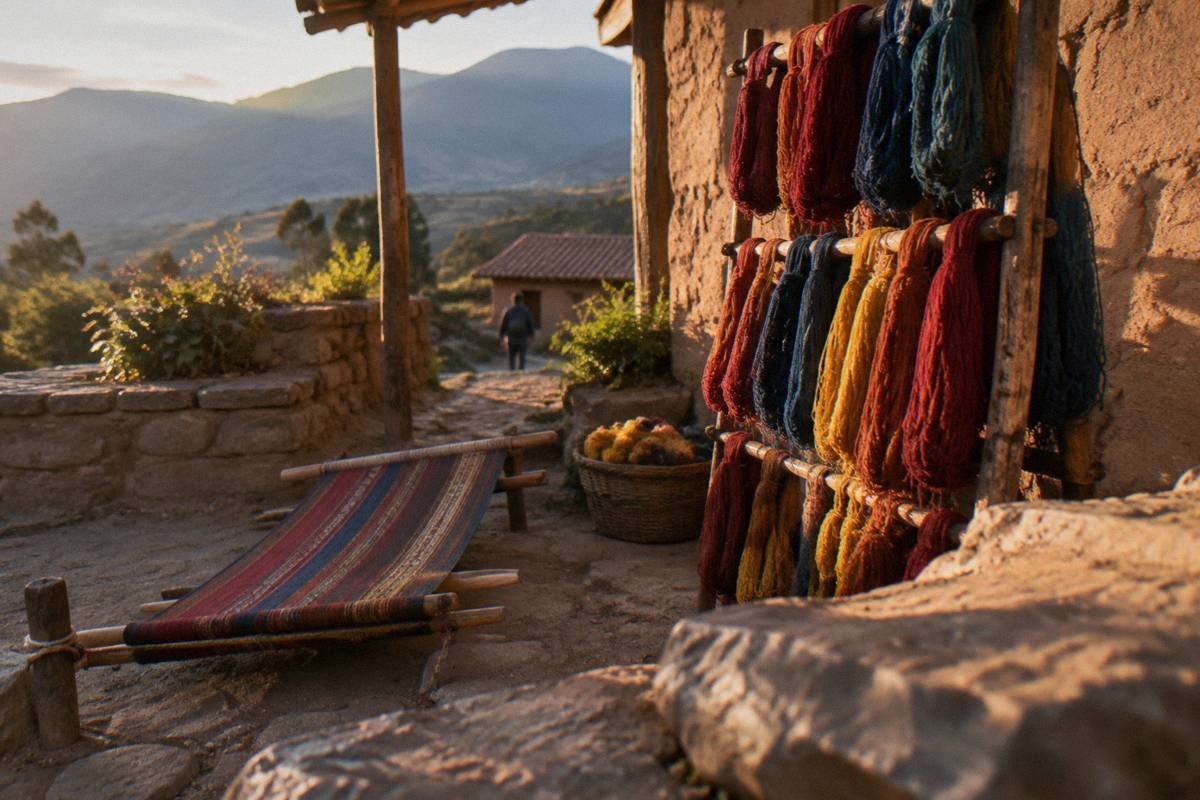
Weave and dye follow. A loose weave shows light through the fabric when it is held up, and a dense one does not; the denser blanket took more hours at the loom. Natural dyes, drawn from plants and minerals, produce subtler colours and a longer process than synthetic dyes, which are brighter and cheaper. Neither is wrong, but they are different products at different prices.
| Price driver | What it means | What to check before paying |
|---|---|---|
| Fibre grade | Baby alpaca and royal alpaca are the finest sorted grades; ordinary fleece is broader and cheaper | Ask the seller to name the grade and touch the blanket against the neck, where softness shows |
| Weave density | More fibre and more hours at the loom go into a tight weave | Hold the blanket up to the light; a dense weave blocks it |
| Dye type | Natural plant and mineral dyes take longer; synthetic dyes are brighter and faster to apply | Ask what the colours came from and compare two blankets side by side |
| Place of sale | A cooperative, a market stall and a city shop carry different overheads | Compare the same fibre grade in two places before deciding |
The point of the table is that every one of these four factors can be checked in person, in minutes, without any reference price. A buyer who does all four checks is very hard to overcharge.
Where Can You Compare Alpaca Blankets Around Cusco?
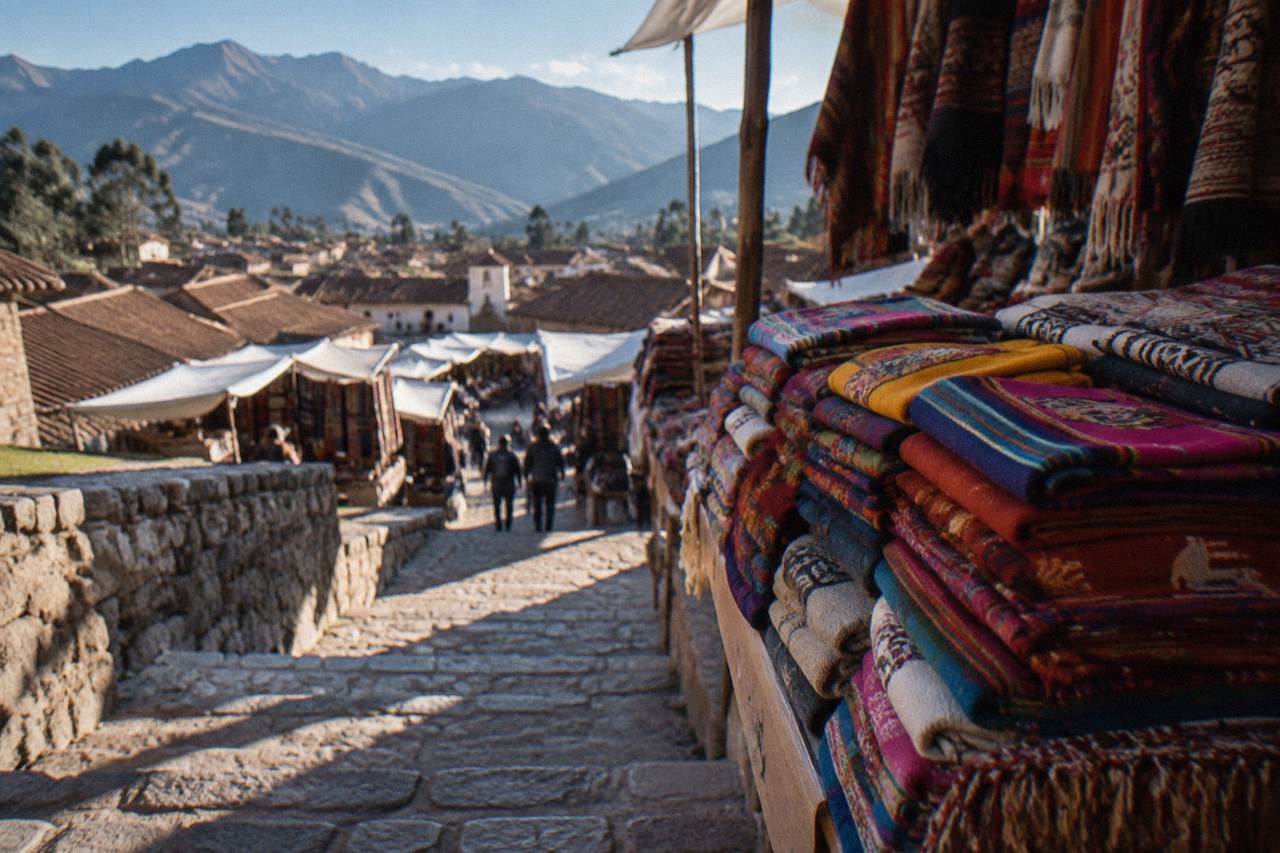
The comparison shopping happens in four kinds of places around Cusco: the city's markets and the San Blas workshops, the Awana Kancha weaving centre on the road out of the city, the artisan towns of the Sacred Valley such as Pisac and Chinchero, and the shops around the Plaza de Armas. Each sells a different mix of fibre grade and price, and the towns sit at lower elevations than the city itself, which matters for anyone planning a day around the trip.
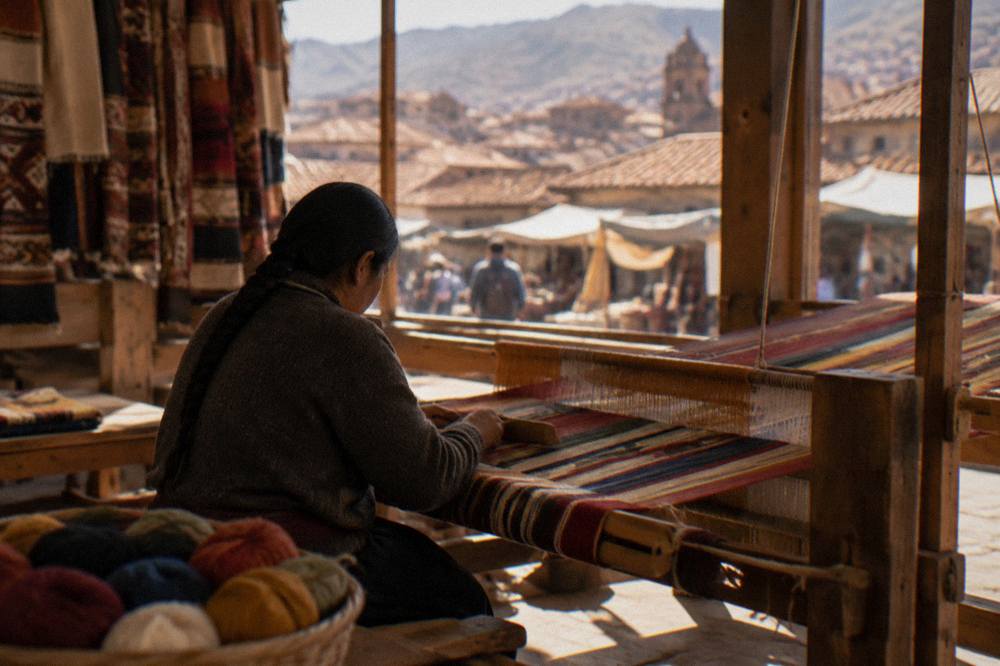
Awana Kancha is the most instructive stop for a first-time buyer, because it exists to demonstrate weaving and dyeing rather than only to sell. The site's Awana Kancha guide describes what the centre shows visitors. Watching a weaver work makes the labour behind a dense weave obvious in a way no label can, and once that labour is visible, the price conversation in a market stall becomes much easier to judge.
The Sacred Valley towns carry their own character. Pisac, at 2,972 m, holds its market and its artisan stalls; Chinchero is a weaving town; Ollantaytambo, at 2,792 m, and Urubamba, at 2,870 m, sit lower still, which makes a valley shopping day a gentler altitude day than a day in the city at 3,335 m. Anyone weighing a valley day against a Machu Picchu day can read Sacred Valley or Machu Picchu first.
| Place to compare | Elevation | Character of the shopping |
|---|---|---|
| Cusco, Plaza de Armas | 3,335 m | City-centre shops, fixed prices, widest range of grades |
| Pisac | 2,972 m | Market town with a strong artisan tradition |
| Urubamba | 2,870 m | Valley town, workshops and cooperatives |
| Ollantaytambo | 2,792 m | Small-town stalls around the archaeological site |
Elevations come from the verified site data, and they are worth knowing for a second reason: a buyer who has just arrived in Cusco and is still acclimatising to about 3,300 m may prefer the lower valley towns for a long day of walking and comparing. The rest of the planning pages sit on Things To Do In Cusco Peru.
How Do You Tell Real Alpaca From A Blend Before Paying?
The reliable checks are the ones a seller can demonstrate on the spot: the label and the fibre grade named for the blanket, the feel of the fabric against the neck, where the seller says it was woven, and whether the seller will state plainly that it is pure alpaca rather than a blend. A stall that answers all four without hesitation is a safer bet than any price comparison, and a vague answer to the fibre question is a reason to keep walking.
Blends are common and not dishonest when they are declared. Alpaca mixed with sheep's wool or with acrylic is a cheaper, hardier product, and it suits a blanket that will be used hard. Pure alpaca, and especially the finer grades, is softer and lighter and priced accordingly. The problem is only the undeclared blend sold at a pure-fibre price, which is the single most common complaint in the shopping streets of the historic centre.
The site's page on what to avoid in Cusco covers the broader street-level pitfalls, and the buying guide linked above goes into label vocabulary in more detail. Between the two, a buyer arrives at the market knowing what to ask and what a vague answer sounds like.
A morning of market comparing pairs naturally with the food side of the same streets. The cooking class with the San Pedro market tour walks the same central market quarter where much of the textile comparison happens, and the ChocoMuseo chocolate workshop sits in the same historic-centre grid, a short walk from the stalls.
When Is The Best Time Of Year To Shop For Alpaca In Cusco?
The dry season, roughly May to September, is the comfortable window for a day of market walking in Cusco: the WMO and SENAMHI historical normal for the city shows May to August bringing just 22.8 mm of rain between them, about 3.2 percent of the year's 707.8 mm. December to March carries 71.9 percent of the annual rain, so wet-season shopping means covered markets and quick dashes between shops rather than unhurried comparing.
The climate record for the city is one of the driest in the verified data. Cusco sits in the southern hemisphere at high altitude, so its seasons run opposite to Europe and North America: June to August is winter, dry and clear by day with frosts at night, and December to March is the wet summer. Mean daily maxima stay between 18.8 and 20.9 C all year, so a shopping day is rarely about heat; it is about rain.
| Month | Mean max C | Mean min C | Rain mm |
|---|---|---|---|
| Jan | 18.9 | 6.6 | 145.3 |
| Feb | 18.8 | 6.5 | 133.7 |
| Mar | 19.1 | 6.2 | 107.0 |
| Apr | 19.7 | 4.9 | 43.2 |
| May | 19.8 | 2.5 | 8.7 |
| Jun | 19.5 | 0.3 | 1.5 |
| Jul | 19.1 | 0.1 | 4.0 |
| Aug | 19.8 | 1.6 | 8.6 |
| Sep | 19.8 | 3.9 | 21.8 |
| Oct | 20.9 | 5.5 | 39.4 |
| Nov | 20.7 | 6.1 | 71.9 |
| Dec | 19.4 | 6.4 | 122.7 |
The figures are the historical normal for the WMO's Cuzco station, supplied by SENAMHI, and they are not a forecast for any given week. What they show clearly is the shape of the year: the wet months are wet, the dry months are almost rainless, and a blanket-buying expedition that involves walking between stalls and workshops is simply more pleasant in the dry half. A wet-season buyer loses nothing except comfort, since the covered markets and shops operate all year.
There is a second, quieter reason the calendar matters. The dry season is also the busy season for the whole region, and the stalls are fully stocked for it. A buyer visiting in the wet months finds fewer crowds and more time to talk, which suits the slow, question-heavy comparison that a good blanket purchase deserves.
Common Questions About Alpaca Blanket Prices In Cusco
How much should I pay for an alpaca blanket in Peru?
No verified price band exists, because no official body publishes one. The price in soles depends on the fibre grade, the weave density, the dye type and the place of sale, and comparing two or three blankets in person tells a buyer more than any figure quoted online. The currency is the Peruvian sol, at about S/ 3.4 to the US dollar.
Is baby alpaca better than regular alpaca?
Baby alpaca is a fibre grade, not an age: it refers to the finest sorted fleece, which is softer and scarcer than broader grades. It commands a higher price for that reason. A blanket of ordinary alpaca fleece is a legitimate, hardier product at a lower grade, provided the seller declares what it is.
Are alpaca blends a bad buy?
Not when they are declared. Alpaca mixed with wool or acrylic is cheaper and more durable, and suits a blanket that will be used hard. The only dishonest version is an undeclared blend sold at a pure-alpaca price, which is why asking the seller to state the fibre plainly is the single most useful question in the transaction.
Is it better to buy an alpaca blanket in Cusco or in the Sacred Valley?
Both work, and neither has a verified price advantage. The city offers the widest range of grades and fixed-price shops around the Plaza de Armas at 3,335 m, while valley weaving towns such as Pisac at 2,972 m and Chinchero sell closer to the source. Comparing the same fibre grade in both places is the only reliable way to judge.
What time of year is best for shopping for textiles in Cusco?
The dry season, roughly May to September, is the comfortable window: the historical climate normal for the city shows May to August bringing just 22.8 mm of rain between them. December to March carries 71.9 percent of the year's rain, so wet-season shopping means covered markets rather than unhurried street comparing.
How do I avoid overpaying for an alpaca blanket?
Ask four questions and expect four plain answers: what fibre grade it is, how dense the weave is, what the dyes came from, and where it was woven. A seller who answers all four without hesitation is pricing honestly at whatever level of quality the blanket represents. The site's guide to buying alpaca in Cusco goes deeper into the label vocabulary.
A blanket bought with those checks is a purchase that holds up: the fibre grade was named, the weave was held to the light, the dye was explained, and the price was compared in at least two places. That is the whole method, and it costs nothing but an afternoon in one of the best textile towns in the Andes.